
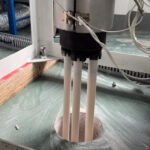
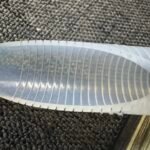
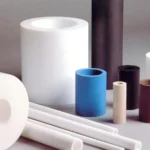
If you’ve ever pulled a preform out of the mold and seen one side dense as a brick while the other looks like it barely saw any pressure, you know exactly how frustrating PTFE preforming can be. I’ve been there—staring at cracked billets, wasted powder, and a production schedule that’s suddenly two days behind. After 18 years running PTFE compression lines and helping dozens of factories fix the same headache, I’ve learned that 95 % of density problems start way before the ram even touches the powder. They start with how the PTFE powder behaves in the hopper and shoe.
Let’s fix that today—no fluff, just stuff that actually works on the shop floor.
Why PTFE Powder Acts Like a Toddler on Sugar
PTFE powder isn’t like most thermoplastic powders. It’s super hydrophobic, has almost no moisture absorption (usually <0.01 %), and the particles love to cling to each other because of static and low surface energy. The result? Bridging, rat-holing, flooding, and density variations that can swing ±15 % from one preform to the next if you’re not careful.
Real data from DuPont’s old Teflon® technical bulletins (still the bible for many of us) shows that free-flowing fine-cut PTFE resin typically has a bulk density around 450–550 g/L untreated, but once you start moving it through hoppers and feeders, that number can drop 20–30 % just from poor handling.
Getting the Powder to Flow Like It Should
1. Particle Size Distribution Is Everything
Most factories just look at “average particle size” on the COA and call it a day. Wrong move. What kills flow is the fines fraction (<50 μm). Too many fines = packing like wet sand. Too few = the powder flows so fast it floods the die.
Quick rule I’ve used forever:
- For billets under 200 mm diameter → aim for 20–30 % fines
- For large billets 400 mm+ → drop to 12–18 % fines
We once switched a customer in Jiangsu from a Chinese resin with 42 % fines to a Daikin Polyflon grade with 24 %. Powder flow time (ASTM D1895) went from 48 seconds to 19 seconds, and preform density variation dropped from 9.8 % to 2.1 %. Same PTFE Preforming Machine, same operator, just better powder spec.
2. Conditioning the Powder (The Step Everyone Skips)
Fresh PTFE powder straight out of the drum is usually compacted and full of static. Here’s the routine that saved my sanity:
- Tumble blend for minimum 20 minutes in a double-cone or V-blender
- Temperature condition to 23–27 °C (above 19 °C transition to avoid crystallinity changes)
- Relative humidity control <30 % (yes, even though it’s hydrophobic, humidity affects static on metal surfaces)
Pro tip: add 0.02–0.05 % silica flow agent if your customer allows it. Drops angle of repose from ~45° to ~32° instantly.
Bulk Density vs. Apparent Density vs. What Actually Ends Up in Your Billet
| Недвижимость | Typical Range (Fine Cut) | What Affects It Most | Target for Consistent Preforms |
|---|---|---|---|
| Untapped Bulk Density | 400–550 g/L | Fines content, moisture | 480–520 g/L |
| Tapped Bulk Density (100 taps) | 600–750 g/L | Particle shape, flow agent | <10 % increase from untapped |
| Apparent Density in Die | 1.50–1.80 g/cm³ | Fill height, shoe speed | ±0.02 g/cm³ variation max |
| Final Preform Density | 2.10–2.20 g/cm³ | Pressure dwell, powder flow | ±0.03 g/cm³ across height |
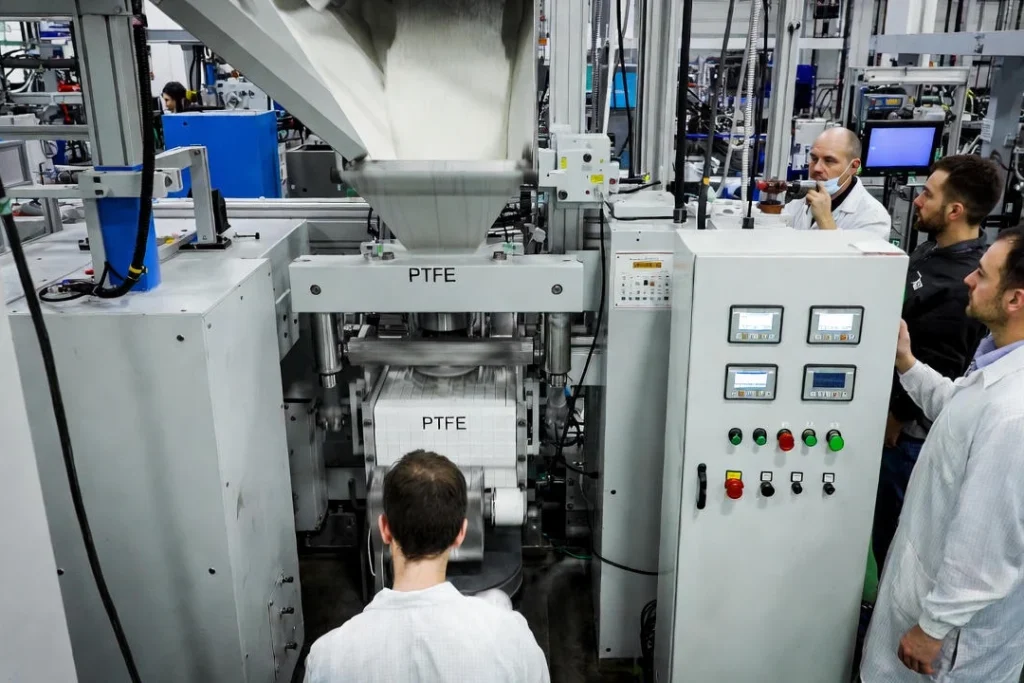
Machine Settings That Actually Matter on Your PTFE Preforming Machine
I’ve run machines from small 50-ton lab presses all the way to 800-ton automatic lines. Here are the settings that separate “it kinda works” from “we haven’t had a cracked billet in 18 months”:
Fill shoe design & speed
Switch to a gravity-fed shoe with diffuser plates instead of the old straight dump. Slow the shoe to 8–12 cycles/minute. Faster than that and you get segregation.
Vacuum assist
Pull 400–600 mmHg vacuum for 15–30 seconds before compression. Removes trapped air that causes density gradients. One factory in Germany went from 11 % scrap to 0.8 % just adding this.
Dwell time under pressure
Minimum 30 seconds at full pressure, sometimes 90 seconds for thick billets. PTFE doesn’t creep like UHMWPE—it needs time for particles to nest properly.
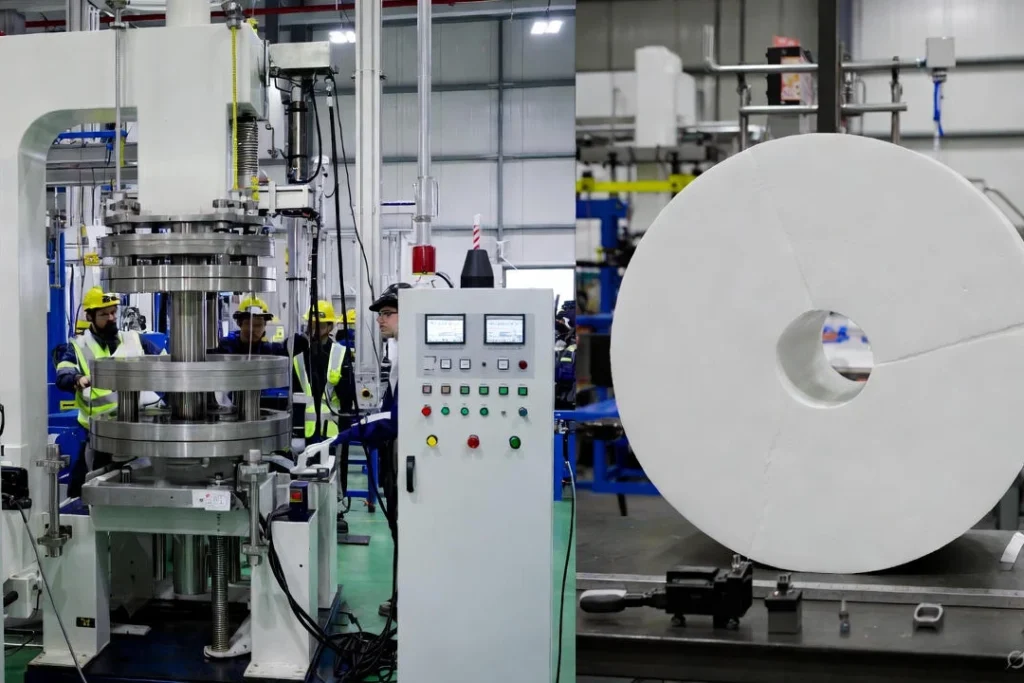
We build our Машина для формования ПТФЭ with programmable vacuum sequences and ultra-precise shoe control for exactly these reasons. Customers tell us the difference is night and day compared to older Chinese or European presses.
Real Case: 420 mm Billet That Used to Crack Every Time
Customer in Texas was making 420 mm × 1200 mm billets for semiconductor vessel liners. Every single one cracked during sintering. Density scans showed top 50 mm at 2.08 g/cm³ and bottom at 2.19 g/cm³—huge gradient.
What we changed:
- Added powder conditioning room (25 °C, 25 % RH)
- Installed our automatic PTFE Preforming Machine with dual vacuum and slow shoe
- Switched to resin with tighter PSD
- Increased dwell to 75 seconds
Result: density variation dropped to 0.018 g/cm³. Zero cracks in over 800 billets since 2023. They actually sent me a photo of the first perfect batch with “You saved my marriage” written on the box. True story.
Troubleshooting Your Current Density Problems (Quick Checklist)
- Powder bridging in hopper? → Add a bin activator or pneumatic knocker
- Density higher in the center? → Shoe moving too fast or no diffuser
- Low spots around the edges? → Uneven die fill or worn die wall lubrication
- Random soft spots? → Temperature variation in powder (check your drum storage)
The One Thing That Fixed 80 % of Problems I Ever Saw
Honestly? Weigh every single fill. Not “trust the volumetric feeder.” Actual load-cell weighing of each charge. Sounds basic, but I can’t tell you how many factories run “by eye” or with a broken counter. Once you know you’re putting exactly the same mass in every time, half the battle is won.
FAQ – Stuff People Ask Me All the Time
Q: Can I just use a bigger press to force uniform density?
A: Nope. Higher pressure just amplifies whatever variation already exists in the powder fill. I’ve seen 1000-ton presses make worse gradients than a well-tuned 200-ton.
Q: Is there a “magic” PTFE powder that never causes problems?
A: Wish there was. Daikin G163, AGC Fluon G190, and the new 3M Dyneon TF2053Z come pretty close for free-flow, but you still need proper handling.
Q: How often should we clean the die between preforms?
A: Every 10–20 shots minimum. PTFE fines build up on walls and change friction dramatically.
Still fighting density gremlins after trying all this? Drop us a line. We’ve helped factories from Shanghai to South Carolina get their preforming dialed in perfectly. Shoot an email to info@teflonmachinery.com or hit the contact page at https://teflonmachinery.com/contact-us/. Happy to look at your powder COA and machine settings—no charge.
You’ll get consistent preforms. Your sintering yield will thank you. And you’ll finally stop losing sleep over cracked billets.
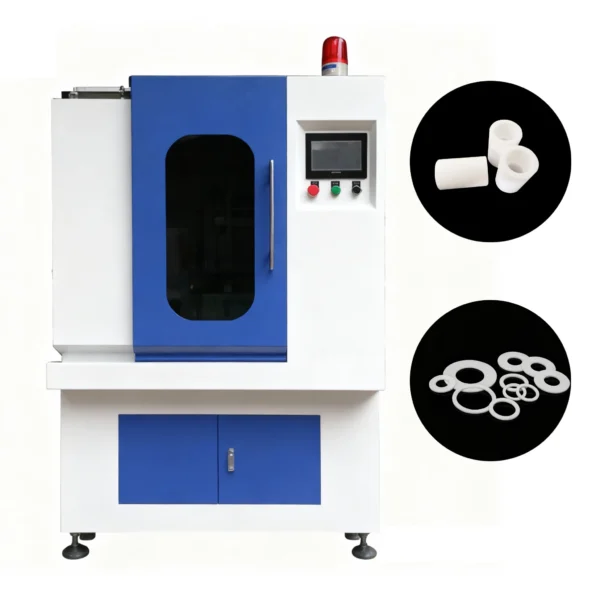
Автоматическая машина для прессования ПТФЭ для уплотнений и прокладок
Наша автоматическая машина для прессования PTFE обеспечивает высокую точность изготовления уплотнений и прокладок из PTFE. Эта машина для прессования тефлона гарантирует стабильное качество и высокую производительность вашей производственной линии. Оцените превосходную эффективность и надежную работу нашей автоматизированной гидравлической прессующей системы, разработанной для сложных промышленных применений.