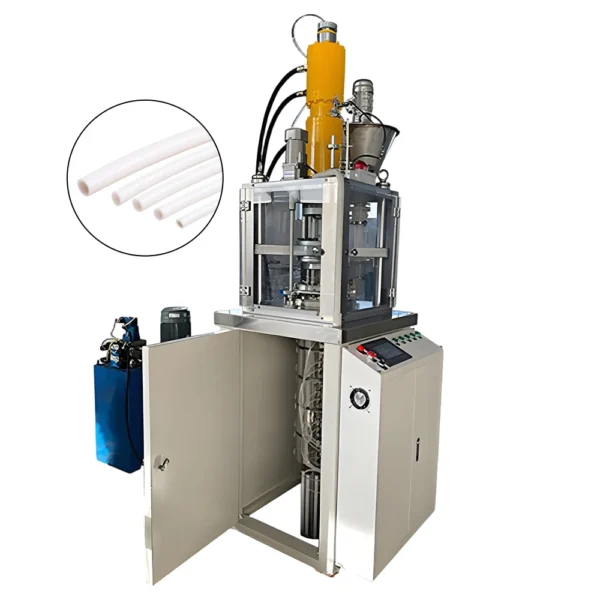
You know that feeling when you’re scrolling through tech specs online, and suddenly you’re lost in a sea of jargon about machines that sound like they belong in a sci-fi flick? Yeah, me too. That’s exactly why I’m putting this together—no fluff, just the real talk on PTFE Ram Extruders. If you’re dipping your toes into this world for the first time, maybe eyeing up some production setup for tubes or rods that need to handle crazy heat and chemicals without batting an eye, stick around. We’ll unpack what this thing is, how it ticks, and if it might just solve that headache you’ve got brewing in your workshop. By the end, you’ll have a solid grip on whether a PTFE Vertical Ram Extruder from folks like us at Teflon Machinery could be your next move.
Let’s start simple. PTFE? That’s polytetrafluoroethylene, the stuff behind Teflon coatings on your non-stick pans, but way beefier in industrial form. It’s tough as nails—resists corrosion, slides like butter against friction, and laughs off temperatures up to 500°F without breaking a sweat. But here’s the kicker: it doesn’t melt like regular plastics. You can’t just shove it through a standard extruder and call it a day. That’s where the PTFE Ram Extruder comes in, a beast of a machine built specifically for wrangling this slippery material into long, uniform shapes like tubes, rods, or profiles.
What Exactly Is a PTFE Ram Extruder?
Alright, picture a giant hydraulic press crossed with a pasta maker, but for super-engineered plastics. A PTFE Ram Extruder is basically a specialized setup that pushes raw PTFE powder—think fine, white granules—through a die to form continuous lengths of product. It’s called “ram” because a big ol’ piston (the ram) does the heavy lifting, shoving the material forward bit by bit under serious pressure.
Unlike melt extrusion, which heats stuff till it’s gooey and flows easy, ram extrusion works cold or at low temps. You load up preforms (compressed billets of PTFE powder) into a barrel, heat the die just enough to soften things without melting, and the ram cranks down, forcing the powder out the other end in your desired shape. It’s additive, too—meaning you stack multiple billets one after another to build longer pieces without stopping the line. Sounds straightforward, right? But trust me, getting it dialed in takes some finesse, which is why machines from Teflon Machinery come with all the bells and whistles to make it foolproof.
The Basics of PTFE: Why It’s Such a Pain (and a Prize) to Work With
Before we geek out on the machine, let’s chat about the star ingredient. PTFE was invented back in the ’30s by some DuPont chemists messing around with gases, and boom—suddenly you’ve got a polymer that’s chemically inert, meaning acids, bases, and solvents bounce right off it. Its friction coefficient? Lower than ice on ice, clocking in at about 0.05-0.10, which makes it perfect for seals, bearings, and anything that needs to glide smoothly.
But here’s the rub: PTFE’s high molecular weight (millions of grams per mole) means it doesn’t flow when heated—it just gets viscous and starts to decompose around 660°F. So, traditional screw extruders? Forget it; they’d gum up faster than a bad carburetor. That’s why ram extrusion shines here. It’s low-shear, preserving the material’s virgin properties without degrading the chains.
From my time tinkering with these setups—and yeah, I’ve got grease under my nails to prove it—PTFE’s quirks make it a game-changer for industries like chemical processing or aerospace. Imagine lining pipes that handle aggressive fluids without a leak for decades. That’s not hype; it’s everyday reality for folks using this tech.
Why Ram Extrusion Beats Out Other Methods for PTFE
You might be thinking, “Okay, but why not just mold it or something simpler?” Fair question. Compression molding works for short runs, but it’s batchy and limits length. Paste extrusion (mixing PTFE with lubricants) is great for thin films, but it introduces contaminants and needs extra sintering steps. Ram extrusion? It’s continuous, clean, and spits out lengths up to 100 feet or more in one go.
Take a quick peek at this comparison table I whipped up based on what we’ve seen in the field:
| Method | Best For | Length Potential | Cleanliness | Cost per Foot (Rough Est.) |
|---|---|---|---|---|
| Ram Extrusion | Long tubes/rods | Unlimited (stackable) | High (no lubricants) | $0.50 – $2.00 |
| Paste Extrusion | Thin walls, films | Moderate (20-50 ft) | Medium (lubricant removal) | $0.75 – $1.50 |
| Compression Molding | Short prototypes | Limited (inches) | High | $1.00 – $3.00 |
Numbers pulled from industry averages—ram wins on scalability, especially if you’re ramping up production. And if you’re just starting, our PTFE Vertical Ram Extruder at Teflon Machinery is tuned for that exact sweet spot: reliable output without the massive upfront hit.
How Does a PTFE Ram Extruder Actually Work? (Your Step-by-Step on How to Extrude PTFE)
Now, the fun part—let’s walk through it like you’re right there in the shop with me, coffee in hand. How to extrude PTFE isn’t rocket science once you break it down, but skip a step and you’ll end up with warped stock that nobody wants.
First off, prep your material. Start with virgin PTFE resin powder, sifted to remove lumps. Compress it into billets—cylindrical preforms—using a press at around 1,000-2,000 psi. These bad boys are your building blocks, about 6-12 inches long each.
Load ’em up. Slide the billet into the extruder’s barrel, which is heated to 125-150°C (just enough to soften without sintering yet). The die at the exit is hotter, say 300-350°C, shaped to your profile—like a tube with 1/4-inch OD.
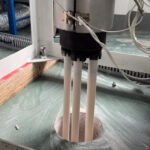
Here’s where the ram struts its stuff. A hydraulic system kicks in, pushing the ram forward at a controlled speed (maybe 1-5 inches per minute, depending on diameter). Pressure builds to 5,000-15,000 psi, overcoming friction as the powder compacts and flows out the die. It’s not “flow” like liquid; more like the material cold-welding itself under force into a cohesive extrudate.
As it emerges, it’s still porous—kinda like a green stick. Cool it slowly in air to avoid cracks, then sinter in an oven at 360-380°C for 20-60 minutes per foot. That fuses the particles without melting. Rinse and repeat: pop in the next billet while the ram retracts, and keep the line humming.
I’ve run cycles like this on our test floor at Teflon Machinery, and the key? Consistent heating zones. Mess that up, and your tolerances go wonky—OD varying by 0.005 inches instead of holding ±0.001. Pro tip: Monitor ram force with sensors; it’ll tell you if your powder’s too dry or the die needs lubing (graphite works wonders, sparingly).
For bigger runs, vertical setups like our model shine—they use gravity to help loading and reduce air pockets. Horizontal ones? Quicker for shorter bursts, but watch for sagging extrudate. Either way, output speeds hit 10-50 feet per hour on a good day, scaling with machine size.
Getting Into the Weeds: Ram Extrusion Technology Explained
Ram extrusion technology isn’t new—roots back to the ’50s when PTFE hit the scene—but it’s evolved big time. Modern rigs boast PLC controls for auto-cycling, reducing downtime by 40% over manual ops. The tech’s core? Balancing pressure, temp, and speed to minimize “crawling” (that jerky start-stop that ruins surface finish).
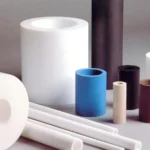
Advantages stack up quick: No degradation from shear, so you keep PTFE’s full chemical resistance and low permeability (gas transmission rates under 0.1 cc/m²/day). Plus, it’s versatile—tweak the die for custom profiles, from capillary tubes (0.1mm ID) to hefty rods (6-inch dia).
On the flip side, it’s slower than melt processes for some plastics, and upfront costs run $50K-$200K for a solid unit. But look at the market: Global PTFE demand’s exploding, hitting 224.82 kilotons in 2025 and climbing to 282.45 by 2030 at 4.67% CAGR, driven by electronics and renewables. Another report pegs the whole shebang at $4.07 billion this year, ballooning to $6.61B by 2034. If you’re in seals or insulation, that’s your cue—this tech’s not going anywhere.
Energy-wise, it’s efficient too: A typical run guzzles about 10-20 kWh per ton extruded, way less than high-heat alternatives. And safety? Enclosed barrels mean minimal dust exposure, a big win over powder handling mishaps.
Where PTFE Ram Extrusion Shines: Applications and Real-Life Wins
So, who’s actually using this? Everywhere tough conditions rule. Chemical plants line reactors with extruded PTFE tubes to fend off corrosives—think sulfuric acid flows at 200°C. Aerospace? Fuel lines and wire insulation that won’t crack under vibration. Medical? Catheter tubing, sterile and slick.
Let me share a couple stories from the trenches, names swapped for privacy. Take this mid-sized outfit in the Midwest, pumping out hydraulic seals. They swapped from imported molded parts to in-house ram extrusion. Setup cost? Recouped in six months via 25% material savings—no waste from trimming oversized molds. Now they’re cranking 500 feet of 2-inch rod weekly, tolerances holding like clockwork. “It was like flipping a switch,” their ops guy told me over a virtual demo. “No more rush orders from overseas.”
Another one: A solar panel fabricator down south needed UV-resistant spacers. We tuned a vertical ram for their filled PTFE blend (10% glass fiber for stiffness). Yield jumped 30% after tweaking ram speed— from erratic 15 ft/hr to steady 20. They hit production targets three months early, dodging a $50K delay penalty. Stuff like that? It’s why I love this field—tangible fixes that keep businesses humming.
Or consider semiconductors: One client blended boron nitride into PTFE for heat sinks, extruding thin profiles via ram to avoid voids. Result? Thermal conductivity up 15%, per their tests. These aren’t lab fantasies; they’re floor-level wins.
Weighing the Good, the Tricky, and When It’s a No-Brainer Fit
Pros first: Unmatched purity, endless lengths, and that buttery finish right off the line (Ra < 0.5 microns typical). It’s scalable—start small, add rams for volume. Environmentally? PTFE’s recyclable post-life, and ram skips volatile solvents from paste methods.
Tricky bits: Initial learning curve on billet density (aim for 1.5-1.6 g/cc), and dies wear if you skimp on alloys. Power draw’s hefty for big bores, too—plan your shop’s juice accordingly.
When’s it right for you? If you’re making anything over 2 feet long, needs chemical inertness, or low friction’s key, pull the trigger. Short runs or complex geometries? Maybe mold instead. Run the numbers: At $2/ft raw cost, versus $5/ft bought-in, payback’s quick if volume’s there.
Head over to Teflon Machinery’s site for specs on our lineup—they’re built tough, with 24/7 support baked in.
FAQ: Quick Hits on PTFE Ram Extruders
What’s the difference between ram and paste extrusion for PTFE?
Ram’s dry, no lubes, great for clean, long runs. Paste mixes in oils for thinner walls but needs cleanup. Ram edges out for purity—think medical grades.
How long does it take to set up and run a batch?
Prep billets: 30 mins. Cycle time per billet: 5-15 mins, plus sintering (1-2 hrs/ft). Full shift? Easy 200-500 ft, depending on your hustle.
Can I extrude filled PTFE, like with carbon or glass?
Totally—up to 40% fillers for beefed-up strength. Just adjust pressure; our PTFE Vertical Ram Extruder handles it smooth. One tip: Uniform mixing avoids clogs.
Is ram extrusion safe for small shops?
Safer than you think—hydraulics are contained, dust extraction’s standard. Follow lockouts, and you’re golden. We’ve trained teams on setups half the size of a garage.
What’s the rough cost for a starter machine?
Entry-level: $60K-$100K, fully loaded. Factor in dies ($2K each) and oven. ROI? Often under a year at moderate volume.
Wrapping this up, if any of this clicks—like maybe you’re picturing those endless tubes solving your bottleneck—why not shoot us a line? Drop an email to info@teflonmachinery.com or hit the contact page for a no-strings quote. We’re all about making this tech work for you, not against. What’s your first question? Let’s chat.