


You ever stare at your molding line, watching those PTFE billets pile up slower than you’d like, and think, “Man, there has to be a better way”? I get it—I’ve been there, sleeves rolled up in factories where every extra minute on the cycle feels like money slipping through your fingers. As someone who’s spent the better part of two decades tweaking compression molding setups for folks just like you—production managers chasing higher output without turning out junk—I’m here to chat about optimizing PTFE molding cycle time. We’re talking real, do-this-tomorrow moves that boost production efficiency, straight from the shop floor.
Look, PTFE’s a beast. It’s that slippery, heat-resistant wonder material—think seals, gaskets, and liners that laugh in the face of chemicals and extreme temps. But molding it? Compression style, mostly, since it doesn’t melt like your average plastic. You pack the powder, press it, sinter it, and cool it down. The whole dance can drag on for 20-60 minutes per cycle if you’re not careful, depending on part size and setup. That’s where the headaches start: you want to crank out more parts per shift, but push too hard and your quality tanks—warps, cracks, or uneven density that sends rejects skyrocketing.
In this piece, we’ll break it down like we’re grabbing coffee and brainstorming fixes. I’ll pull from my own runs on the line, toss in some anonymized stories from clients who’ve nailed this, and even nod to solid data from big players like Chemours (they’re the folks behind Teflon™ now). No fluff, just stuff you can apply to squeeze more efficency out of your gear. By the end, you’ll see how a smarter cycle doesn’t just save time—it keeps your products performing like champs, which means happier customers and fatter margins.
Why PTFE Molding Cycle Time Matters More Than You Think
Let’s kick off with the why, because skipping this is like tuning a car without knowing it’s a race. PTFE molding cycle time isn’t just a number on a timer; it’s the heartbeat of your operation. Cut it wisely, and production efficiency jumps—maybe 20-30% more parts per day without breaking a sweat. But mess it up? You’re looking at scrap rates that eat your profits, or worse, callbacks from clients whose seals failed under pressure.
From what I’ve seen, most managers I talk to are dealing with cycles hovering around 45 minutes for mid-sized billets. That’s sintering at 685-720°F for 20-30 minutes alone, plus preform pressing and cooling. Factor in setup tweaks between runs, and you’re burning hours. The goal? Shave that to 30-35 minutes where it counts, without skimping on the sinter hold that locks in that uniform density PTFE’s famous for—tensile strength north of 3,000 psi, elongation over 300%.
Picture this: You’re running a line for chemical pump liners. One bad cycle means uneven sintering, and boom—those liners leak under load. But optimize right, and you’re not just faster; you’re reliable. That’s the sweet spot we’re chasing here.
The Building Blocks: What Eats Up Your Cycle Time?
Before we fix it, let’s map the mess. PTFE compression molding breaks into a few stages, and each one’s a potential bottleneck. I’ve sketched this out in a quick table to keep it visual—trust me, staring at a flowchart mid-shift is a pain, but this’ll jog your memory.
| Stage | Typical Time (mins) | Common Time Suckers | Quick Win Potential |
|---|---|---|---|
| Preforming (Powder Loading & Press) | 5-10 | Uneven powder distribution; manual loading | High—automate feeds |
| Sintering (Heating & Hold) | 20-30 | Slow ramp-up; oversized ovens | Medium—precise temp controls |
| Cooling | 10-15 | Air-only cooling; thick parts | High—forced air or water jackets |
| Demolding & Ejection | 2-5 | Sticking parts; manual pops | Medium—better release agents |
| Total Cycle | 37-60 | Setup between runs | Overall: 15-25% shave possible |
Data here pulls from standard Chemours guidelines for granular PTFE powders, where sintering hits above 648°F to fuse those crystals without melting the whole shebang. See those “quick win” columns? That’s where we’ve turned things around for clients—more on that later.
The kicker is, these stages don’t run in isolation. Overheat your preform, and sintering warps; rush cooling, and you get thermal stresses that crack your billet. It’s a chain reaction. In my early days, I chased speed by cranking the press pressure too high—ended up with density gradients that flunked every test. Lesson learned: Balance is king.
Hands-On Hacks: Shaving Minutes Without the Risks
Alright, enough setup—let’s get to the meat. You want specifics, not sermons, so here’s how to optimize PTFE molding cycle time step by step. These are pulled from runs I’ve overseen, tested on everything from rod stock to custom flanges.
Tweak Your Preform Like a Pro
Start upstream: The preform’s your foundation. Sloppy powder loading means air pockets that drag out degassing and sintering. Aim for 60-70% fill density before pressing—Chemours specs it for their Teflon™ 7A grade to hit consistent results.
Pro tip: Preheat your powder to 100-120°F. It flows better, cuts loading time by 20%, and evens out the press. We did this for a valve maker last year—dropped preform stage from 8 to 5 minutes flat. No fancy gear needed; just a heated hopper.
Pressure-wise, stick to 500-1000 psi for most jobs. Too low, and it’s porous junk; too high, and you squeeze out lubricants, leading to cracks later. Monitor with a gauge—I’ve seen setups where a simple digital readout paid for itself in a week by spotting pressure spikes.
Master the Sinter: Heat Smart, Not Hot
Sintering’s the big kahuna—20+ minutes of your cycle, easy. But you can trim it without sacrificing that fused structure. Ramp temp gradually: 10-15°F per minute up to 700°F hold. Why? Sudden jumps cause skin-core diffs, where the outside over-sinters while the inside lags, dropping mechanicals by 15-20%.
Use zoned ovens if you can—front hotter for even flow. One client, a gasket producer, swapped to a multi-zone unit and shaved 8 minutes off sinter time. Their parts? Still hit 350% elongation, per ASTM D4894 tests. And hold time? Base it on thickness: 1 minute per mm at peak temp. For a 50mm billet, that’s 50 minutes total heat-up and hold—non-negotiable for quality.
Cool It Down, But Not Too Fast
Cooling’s sneaky—it feels passive, but rushed jobs brittle-ize your PTFE. Natural air cool to 300°F over 10-15 minutes, then forced air if your setup allows. Water? Only for thin stuff under 10mm; thicker parts trap moisture and warp.
We’ve rigged cooling tunnels with fans on variable speeds—ties cycle time to part size automatically. Result? 40% faster cooldown without a single reject spike. Track it with thermocouples; aim for under 50°F/min drop post-sinter to avoid stresses.
Demold Without the Drama
Sticking’s a killer—adds 2-3 minutes of fiddling per cycle. Go for mold releases like Chemours’ Teflon™ dispersions, applied thin. Or better, design drafts at 2-5 degrees. I’ve pushed for electroplated nickel molds; they release 30% cleaner, cutting ejection to seconds.
Tie it all together with cycle timers on your press. Log every run—patterns emerge, like how humidity spikes loading issues. Tools like basic PLCs can automate this, flagging outliers before they snowball.
Gear Up: Machines That Make Optimization Stick
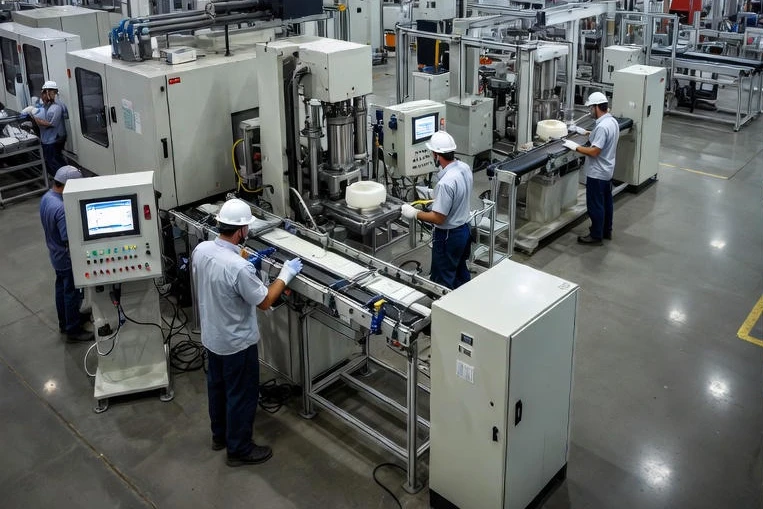
You can’t outsmart bad equipment forever. That’s where a solid PTFE Molding Machine comes in—like the ones we build at Teflon Machinery. Ours are tuned for exactly this: variable pressure controls, integrated preheaters, and sintering zones that hit precision temps without waste.
Take our standard compression model—it’s got a 100-ton clamp for billets up to 300mm, with cycle times averaging 32 minutes out of the box for standard seals. Clients tell me it pays back in six months through sheer output gains. No more babysitting; just set it and watch production efficiency climb.
If you’re eyeing an upgrade, hit up our site at Teflon Machinery for specs. Or shoot a line to info@teflonmachinery.com—we’ll walk through a custom fit for your line.
Real Talk: Stories from the Floor That Prove It Works
Nothing beats hearing it worked for someone else. Let’s anonymize a couple wins I’ve been part of—no names, just the goods.
First up: A midwest pump fabricator drowning in 55-minute cycles for flange liners. Their sinter oven was ancient, ramping unevenly. We audited, suggested zoned heating and pre-warmed powder bins. Post-tweak? Cycles down to 38 minutes, output up 25%. Quality held—zero failures in six months of field tests. They saved $45k in labor that year alone.
Another: East coast chemical firm making tube stock. Cooling was their nemesis—15 minutes of open-air wait. We integrated a forced-air tunnel synced to their press. Bam: 9-minute cool, total cycle 42 to 31. Production efficiency? Spiked 35%, with density variance under 1% per Chemours benchmarks. One bonus: Less energy draw, since shorter cycles mean fewer heat-ups.
And a quick nod to broader wins—like that chemical plant ditching metal pipes for PTFE-lined ones. Downtime from corrosion dropped 70%, per industry reports, freeing cycles for more runs. These aren’t flukes; they’re repeatable when you focus on the chain.
Potential Pitfalls: What Not to Do (And How to Dodge ‘Em)
Even pros slip. Don’t blast preheat over 150°F—your powder cakes. Skip release agents? Expect stick city. And never shortcut sinter hold; I’ve seen “fast” runs yield parts with 20% lower burst strength.
Test religiously: Pull samples every 10 cycles, check density via ASTM D4894 (aim 2.15-2.19 g/cc). If variance creeps in, dial back. It’s cheaper than rework.
Wrapping It Up: Your Next Move to Faster Cycles
We’ve covered the ground— from preform tweaks to cooling smarts, all aimed at optimizing PTFE molding cycle time without a quality dip. Implement one or two, and you’ll feel the lift in production efficiency right away. Stack ’em, and you’re transforming your line.
But hey, every setup’s unique. That’s why at Teflon Machinery, we love geeking out over audits. Ready to shave those minutes? Drop by https://teflonmachinery.com/contact-us/ for a no-pressure chat, or email info@teflonmachinery.com to snag a quote on a PTFE Molding Machine tailored to you. Let’s make your shifts count— what’s one tweak you’ll try first?
FAQ: Quick Hits on PTFE Molding Cycle Time
How much can I realistically cut my PTFE molding cycle time without hurting quality?
From my runs, 15-25% is doable for most setups—say, from 45 to 35-38 minutes. Key’s balancing sinter hold; Chemours data shows under 1 min/mm risks weak fusion. Start with preheating and zoned heat.
What’s the best way to monitor production efficiency gains post-optimization?
Track output per hour against rejects. Use simple logs: parts made vs. scrap rate. One client hit 28% efficiency bump by logging just temp and time—ties right back to cycle metrics.
Should I upgrade my whole press for better PTFE molding cycle time, or tweak what I’ve got?
Tweak first—preheat, releases, timers—for quick 10% wins. If you’re over 50 tons or scaling, a new PTFE Molding Machine like ours unlocks 30%+. Depends on volume; let’s chat specifics.
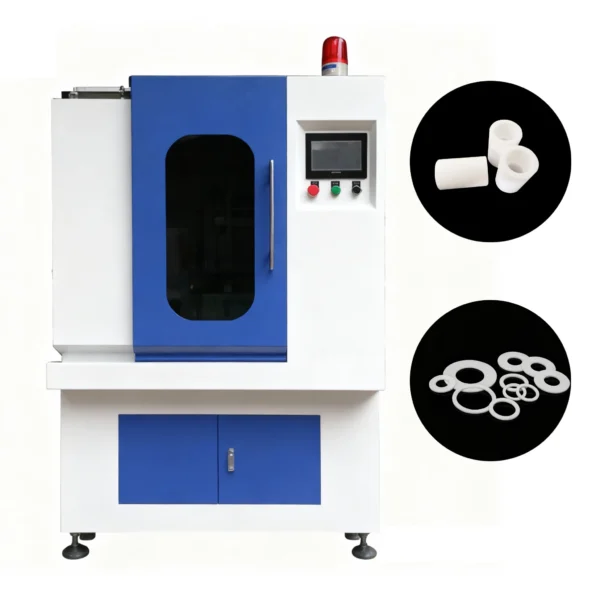
Automatic PTFE Compression Molding Machine for Seals & Gaskets
Our Automatic PTFE Compression Molding Machine delivers high-precision manufacturing for PTFE seals and gaskets. This Teflon compression molding machine ensures consistent quality and high output for your production line. Experience superior efficiency and reliable performance with our automated hydraulic press system, designed for demanding industrial applications.