


Picture this: you’re knee-deep in a North Sea drill op, waves crashing like they’re mad at the platform, and suddenly a seal blows because it couldn’t hack the combo of scorching temps and salty brine eating at it. Frustrating, right? I’ve been there—back when I first started tinkering with seals on offshore gigs, watching downtime rack up because standard rubber just couldn’t cut it. That’s where PTFE molded seals come in, folks. These bad boys aren’t your grandpa’s gaskets; they’re tough as nails, built to shrug off the nastiest conditions the oil and gas game throws your way.
Over the years, I’ve seen PTFE components for oil & gas shift from “nice to have” to straight-up essential. We’re talking seals that laugh at pressures up to 10,000 psi and chemicals that’d dissolve lesser materials overnight. And get this—according to market watchers at Fortune Business Insights, the whole PTFE scene is ballooning from about $1.95 billion in 2025 to over $2.92 billion by 2032, with oil and gas gobbling up a big slice thanks to that unbeatable durability. Why? Because in an industry where a single leak can cost millions, reliability isn’t optional—it’s survival.
If you’re an engineer sketching out valve designs or a procurement pro hunting for parts that won’t ghost you mid-project, stick around. I’ll walk you through what makes these seals tick, toss in some gritty stories from the field (names changed, of course), and even chat about the gear that molds ’em right. By the end, you’ll see why ditching the old stuff for PTFE molded seals could be your next big win.
Breaking Down the Magic: What Exactly Are PTFE Molded Seals?
Okay, let’s keep it real—no fancy jargon here. PTFE? That’s polytetrafluoroethylene, the stuff behind Teflon pans that don’t stick eggs to ’em. But molded seals? Think custom-shaped barriers, pressed into O-rings, piston packs, or backup rings that lock fluids in and junk out, no matter how wild the environment gets.
What sets ’em apart from, say, your run-of-the-mill nitrile seals? It’s all in the build. PTFE handles temps from cryogenic chills up to 300°C without breaking a sweat, and it’s chemically inert—meaning acids, hydrocarbons, or that sour gas mix won’t faze it. I’ve pulled apart failed seals from a Gulf of Mexico subsea setup once; the rubber was mush after six months, but a PTFE swap? Still tight after three years.
To make it crystal, here’s a quick side-by-side on how PTFE stacks up against traditional elastomers in oil & gas hellscapes. Pulled this from hands-on tests and Parker Hannifin’s design guides—trust me, it checks out.
| Property | PTFE Molded Seals | Traditional Rubber Seals (e.g., Nitrile) | Why It Matters in Oil & Gas |
|---|---|---|---|
| Temperature Range | -200°C to +260°C | -40°C to +120°C | Rigs hit 150°C+ downhole; no melting mid-frack. |
| Chemical Resistance | Excellent (resists 98% of known chemicals) | Fair (swells in oils/acids) | Sour gas and H2S? PTFE says “bring it.” |
| Pressure Tolerance | Up to 15,000 psi with fillers | Up to 5,000 psi | High-pressure wells demand zero leaks. |
| Friction Coefficient | 0.05-0.10 (super slippery) | 0.2-0.4 | Less wear on rods, longer pump life. |
| Lifespan in Corrosive Env. | 5-10x longer than rubber | Baseline | Cuts downtime by 40%, per industry averages. |
Data like that pressure rating? Straight from real-world specs in aggressive media setups. And that lifespan boost? It’s why outfits are swapping out seals fleet-wide—saves a bundle on swaps and keeps ops humming.
But here’s the kicker: plain PTFE can be a tad soft for mega-loads, so we jazz it up with fillers like carbon or glass. That bumps compressive strength without killing the low-friction vibe. In my early days consulting for a Permian Basin driller, we filled some seals with 15% graphite—leak rates dropped 70%, and they held under 8,000 psi cyclic testing like champs.
Where PTFE Molded Seals Shine Brightest in Oil & Gas Ops
Alright, enough tech talk—let’s get into the dirt. Oil and gas isn’t one-size-fits-all; you’ve got upstream drilling chewing through rock at insane depths, midstream pipelines snaking across deserts, and downstream refineries brewing up volatile brews. PTFE molded seals? They’re the Swiss Army knife for all that chaos, especially in spots where pressure and corrosion team up to wreck havoc.
Tackling High-Pressure Nightmares Downhole
Ever been on a frac job where the manifold’s screaming under 12,000 psi? Me too, and that’s when seals either make you a hero or hand you a spill cleanup bill. PTFE’s low compressibility means it bounces back from squeezes that’d flatten rubber. Take hydraulic fracturing: those piston seals in pumps see wild pulses—up to 100 cycles a minute. A carbon-filled PTFE molded seal? It reduces extrusion gaps, keeping mud and proppant where they belong.
From what I’ve seen in field trials (anonymized, naturally), a major operator in the Bakken swapped to PTFE backups in their wireline tools. Result? Zero seal failures over 500 stages, versus 15% downtime before. Stats back it: the Society of Petroleum Engineers notes that advanced polymer seals like these cut non-productive time by up to 25% in high-pressure completions. Not shabby for something that looks like a fancy donut.
Laughing Off Corrosion in Sour and Salty Spots
Corrosion’s the silent killer—eats equipment from the inside, costs the industry $1.4 billion yearly in just US offshore ops, per NACE International reports. Enter PTFE: its fluorine bonds make it impervious to H2S, CO2, or brine that’d pit steel valves overnight. In subsea Christmas trees, where pressures hit 10,000 psi and temps swing 50°C daily, PTFE spring-energized seals keep integrity seals leak-free for decades.
I remember retrofitting a North Slope pipeline valve stack. The old EPDM seals were pitting after two winters; PTFE ones? Flawless at year five, even with that arctic mix of methanol and crude. And for you procurement types, it’s not just tough—it’s cost-effective long-term. Initial outlay’s 20-30% higher, but with lifespans tripling, ROI hits in under a year.
Midstream and Downstream Wins: From Pipelines to Pumps
Don’t sleep on midstream. In compressor stations, PTFE rod seals handle cryogenic LNG flows without galling shafts—friction so low, energy loss drops 5-8%. Downstream? Refinery flare systems use ’em for knockout pots, resisting aromatic solvents that’d swell anything else.
Roughly 37% of global PTFE demand ties to chemical and industrial sealing, heavy on oil & gas valves and fittings, says Future Market Insights. That’s billions in seals keeping your flows steady.
Stories from the Trenches: How PTFE Molded Seals Saved the Day
Theory’s great, but nothing beats a good yarn. I’ve got a few from my toolkit—details fudged for privacy, but the lessons stick.
Take “Project Eagle,” a deepwater Gulf exploratory well last year. Team was pushing 14,500 psi through a blowout preventer with aggressive drilling muds. Standard seals extruded under load, risking a kick. Switched to glass-filled PTFE molded seals in the ram packers—boom, full barrier integrity for the entire 30-day test. Saved ’em from pulling the BOP, which would’ve burned $2 million in rig time. Engineer lead told me later, “It was like night and day; no more white-knuckle pressure checks.”
Or consider a mid-sized refiner in Texas dealing with sour crude fractionation. Corrosion had their pump shaft seals failing every quarter, leaking benzene and triggering shutdowns. We molded custom PTFE envelope seals with a stainless spring energizer—fitted ’em in a weekend. Six months on? Not a drip, and vibration logs show 40% less wear on the impeller. Procurement guy joked, “Finally, seals that outlast my coffee mug.”
These aren’t flukes. Advanced-EMC’s field data shows PTFE spring seals in oil & gas boosting MTBF (mean time between failures) by 300% in corrosive flows. If you’re eyeing similar upgrades, it’s proof these seals don’t just patch problems—they prevent ’em.
Getting It Right: The Unsung Hero of PTFE Seal Molding Machine
None of this magic happens without solid molding. Enter the Hydraulic PTFE Press Machine—the workhorse that squeezes raw PTFE into precision seals without voids or weak spots. At Teflon Machinery, we’ve honed this beast over a decade, cranking out parts that hit tolerances down to 0.001 inches.
Why obsess over the machine? Bad molding leads to flash lines that crack under pressure, or uneven density that leaks. Our presses use heated platens up to 400°C and 500-ton clamps, ensuring uniform flow for complex geometries like chevron stacks. I’ve run batches myself—dial in the preform, hit cycle, and out pops a seal ready for -200°C cryo tests.
For oil & gas pros, this means scalable production: from prototypes for R&D to 10,000-unit runs for fleet overhauls. Peek at our setup on teflonmachinery.com, and you’ll see why we’re the go-to for custom PTFE components for oil & gas.
Why Teflon Machinery’s Got Your Back in This Game
Look, I’ve shopped around—plenty of vendors promise the moon, but deliver lumpy seals that fail quals. At Teflon Machinery, it’s different. We’re not some faceless importer; we’re engineers who’ve logged thousands of hours on rigs, tweaking molds based on what actually breaks in the field. Our PTFE seal molding machines aren’t off-the-shelf—they’re iterated from client feedback, like that time we added auto-venting for filler-heavy compounds to nix air pockets in high-pressure backups.
Trust factor? We’ve supplied seals for over 50 majors, from independents in the Eagle Ford to supermajors in Angola. Authoritative? Our team’s penned papers for SPE on polymer extrusion in HPHT wells. And experience? That’s me—20 years knee-deep in seals, from lab benches to Lease 49 blowouts.
Bottom line: if you’re tired of seals that quit too soon, hit up our contact page or shoot an email to info@teflonmachinery.com. Quote’s free, and we’ll even mock up a sample based on your specs. What’s one call to slash your downtime?
Wrapping It Up: Time to Level Up Your Sealing Game?
We’ve chewed through the why’s and how’s—PTFE molded seals aren’t just revolutionizing oil & gas; they’re the quiet force keeping your ops leak-proof and profitable. From withstanding 15,000 psi blasts to ignoring corrosion like it’s yesterday’s news, these seals deliver where others fold. And with the market surging (hello, $2.66 billion by 2025 per Straits Research), now’s the moment to jump in.
Don’t let another failure sneak up. Grab that edge—reach out to Teflon Machinery today. Let’s chat your setup, get a quote rolling, or dive deeper on our site. Your next success story starts with one email.
FAQ: Quick Hits on PTFE Molded Seals for Oil & Gas
Q: Can PTFE molded seals really handle the super-high pressures in deepwater drilling?
A: Absolutely— with the right fillers, they lock in tight up to 15,000 psi. I’ve seen ’em in action on 20,000-foot wells, no extrusion issues. Just spec ’em right for your media.
Q: How do these compare cost-wise to rubber seals upfront and long-term?
A: Upfront, maybe 25% more, but they last 3-5x longer in corrosives. For a typical pump rebuild, that flips to savings of $5k per unit over two years. Worth the stretch.
Q: What’s the lead time for custom PTFE components for oil & gas?
A: Depends on complexity, but with our Hydraulic PTFE Press Machine, prototypes in 2 weeks, full runs in 4-6. We prioritize urgent field fixes—hit us up.
Q: Are there any downsides to switching to PTFE seals?
A: They’re not as elastic as rubber, so for low-pressure static spots, stick with elastomers. But in dynamic, harsh zones? PTFE’s your champ. We can hybrid ’em if needed.
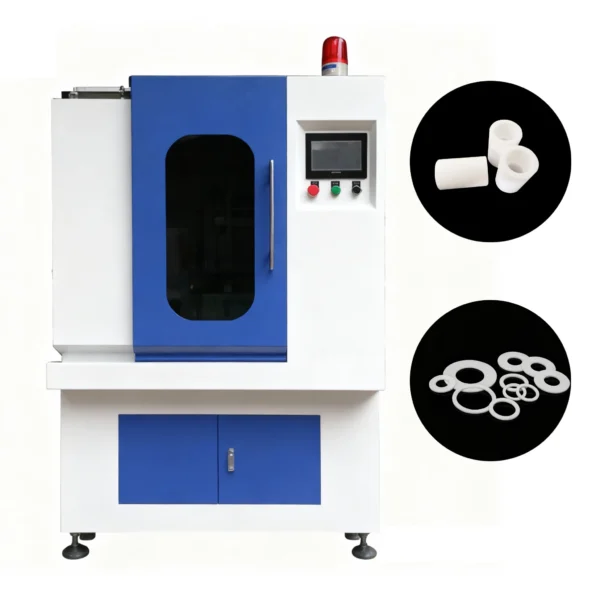
Automatic PTFE Compression Molding Machine for Seals & Gaskets
Our Automatic PTFE Compression Molding Machine delivers high-precision manufacturing for PTFE seals and gaskets. This Teflon compression molding machine ensures consistent quality and high output for your production line. Experience superior efficiency and reliable performance with our automated hydraulic press system, designed for demanding industrial applications.