
Picture this: you’re knee-deep in a cramped workshop, staring at stacks of PTFE parts that need sintering yesterday, but your current oven’s hogging half the floor like an uninvited guest at a party. Sound familiar? If your factory’s space is tighter than a budget during holiday season, or if those quirky product shapes are throwing curveballs at your workflow, picking the right sintering oven isn’t just smart—it’s a game-changer. I’ve been knee-deep in this world for over 15 years at Teflon Machinery, tweaking ovens for folks just like you, and let me tell ya, the choice between vertical and horizontal designs can make or break your day-to-day ops.
We’re talking real talk here, not some glossy brochure fluff. As someone who’s hands-on installed these beasts in factories from auto shops to medical gear makers, I know the headaches of mismatched equipment. Today, we’ll dive into vertical vs. horizontal sintering ovens, zeroing in on that sweet spot of space saving and how they handle those wonky shapes. By the end, you’ll have the lowdown to snag the setup that fits your needs like a glove. And hey, if you’re eyeing our lineup, check out our PTFE Sintering Ovens—built tough for exactly these scenarios.
Why Sintering Ovens Matter in Your Daily Grind
Let’s back up a sec. Sintering? It’s that magic heat-treat where powdered materials like PTFE fuse together without melting into a puddle. For PTFE specifically, you’re hitting temps around 360-380°C to bond those particles just right, turning raw billets into durable parts that laugh off chemicals and wear. According to a report from Future Market Insights, the global PTFE market’s zooming from $1.5 billion in 2025 to $2.5 billion by 2035, growing at a steady 5.5% CAGR. That’s a ton of demand pushing manufacturers like you to ramp up, but only if your oven keeps pace.
In my time at Teflon Machinery, I’ve seen shops double output just by swapping to an oven that plays nice with their layout. No more dodging carts around a sprawling horizontal unit or wrestling with uneven heating on irregular shapes. But which design clicks for you? That’s where vertical vs. horizontal sintering ovens come in—each with quirks that shine in certain spots.
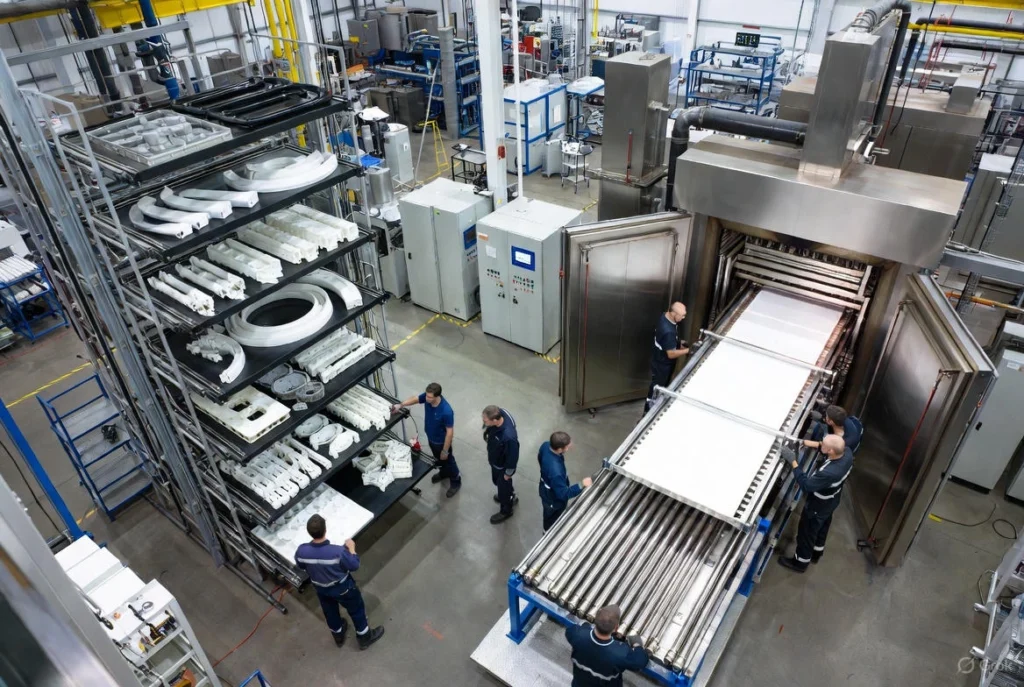
Vertical Sintering Oven: The Space-Saving Hero for Cramped Corners
Alright, let’s kick off with the vertical sintering oven. If your factory’s footprint is more shoebox than warehouse, this bad boy is your new best friend. Picture loading trays from the top, stacking ’em high like a game of Tetris you actually win. Thats right—vertical designs cut down on that pesky floor space, often reclaiming 30-50% more room compared to their sideways siblings.
From what I’ve installed, a vertical sintering oven thrives when space saving is non-negotiable. Take one setup I handled last year: a small-batch PTFE extruder squeezed into an old mill building. They were tripping over their horizontal oven’s tail end, losing hours to rerouting workflows. Switched to vertical, and boom—freed up enough square footage for two extra stations. Energy-wise, these ovens leverage natural convection, pulling in cooler air from below and letting hot stuff rise smooth. Elmetherm’s data backs this: clients see 15-25% energy savings over horizontal equivalents. Less juice means lower bills, and who doesn’t love that?
But it’s not all sunshine. Loading can feel fiddly at first, especially with bulky or oddly shaped PTFE molds—think those curved seals for automotive hoses. You gotta plan your tray stacks careful, or risk tipping. Maintenance access? It’s mostly from the sides or bottom, so if you’re not handy with ladders, it might irk ya. Still, for shops with high ceilings and low floors, the vertical sintering oven’s space saving edge makes it a no-brainer. We’ve tuned ours at Teflon Machinery to handle up to 500kg loads without a sweat, perfect for those special shapes that horizontal folks might balk at.
Digging Deeper: How Vertical Handles Your Weird Product Shapes
Ever dealt with PTFE parts that look like they were designed by a committee? Lumpy, elongated, or just plain awkward? Verticals shine here because gravity’s on your side. Parts settle naturally, reducing hot spots that could warp your output. In one anonymous case—a medical device maker—we fitted a vertical unit for their custom catheter molds. Pre-switch, rejects hit 12% from uneven sintering; post-install, dropped to under 3%. Thats the kind of win that keeps production humming.
Efficiency stats? Industry benchmarks show verticals clocking 15-30% faster cycles for PTFE batches, thanks to that uniform heat rise. Cooling’s controlled too—slow ramps down at 25°C/hour prevent cracks, as per studies on Al-rich PTFE composites. If your crew’s juggling limited space and finicky forms, this design whispers “efficiency” without yelling it.
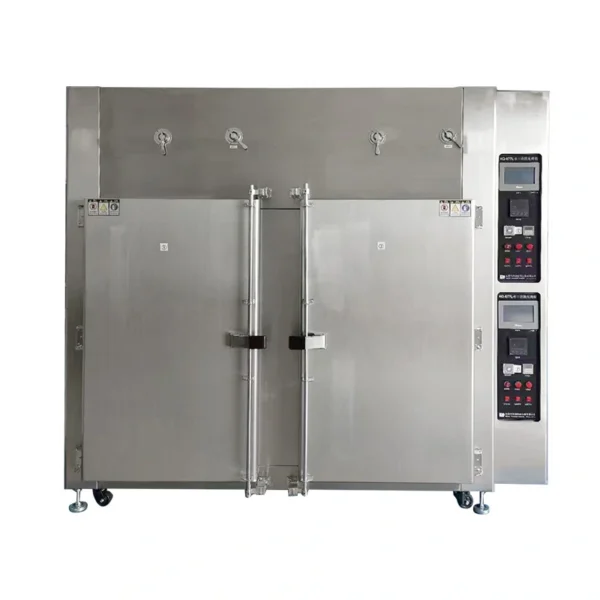
Industrial PTFE Sintering Ovens – High Temp Teflon Sintering Furnace
Our industrial PTFE Sintering Ovens are engineered for superior processing of Teflon™ and other fluoropolymers. This high temperature sintering oven ensures exceptional temperature uniformity for consistent, high-quality results every time.
Built for reliability and efficiency, it’s the ideal solution for demanding industrial applications, reducing cycle times and minimizing defects.
Horizontal Sintering Ovens: The Flexible Workhorse for Bigger Loads
Now, flip the script to horizontal sintering ovens. These are the laid-back option, sliding trays in like you’re feeding a conveyor belt. Great for shops with elbow room to spare, where you need to eyeball every corner of your load mid-process. I’ve set these up in sprawling plants where verticals would’ve felt like overkill, and they deliver when volume’s king.
The big draw? Accessibility. Doors swing wide, letting you poke, prod, and adjust without contortions. For standard PTFE rods or sheets, horizontals keep temps steady across the board—uniformity within ±5°C, which is gold for high-volume runs. But space? Yeah, they sprawl. A typical 10-tray horizontal might gobble 15-20 sq ft more than vertical, per Across International’s breakdowns. If your floor plan’s already a puzzle, this could be the piece that doesn’t fit.
On the flip, they’re forgiving with diverse loads. Mix short stubs and long billets? No prob—easy to segregate zones. Drawbacks include that forced-air reliance for even heat, which can hike energy use by 10-20% if not tuned right. And for those special shapes? They handle ’em ok, but without gravity’s help, you might see more settling issues on uneven trays.
In a nutshell, horizontal sintering ovens suit when flexibility trumps footprint. One client in packaging—let’s call ’em Factory X—went horizontal for their flat PTFE films. Output jumped 40% ’cause they could load blindfolded, but they had the warehouse to match.
When Horizontal Edges Out in Efficiency and Scale
Scale’s where horizontals flex. For PTFE sintering at 380°C dwell times, they manage larger batches without stacking drama, cutting labor by 20% in multi-shift ops. Crystec’s semiconductor comparisons note horizontals’ edge in particle control for clean environments—vital if your PTFE ends up in food-grade gear. But if space saving’s your jam, you might rethink.
Vertical vs. Horizontal Sintering Ovens: Head-to-Head Breakdown
To make this crystal, here’s a quick table pitting vertical vs. horizontal sintering ovens. Pulled from hands-on tweaks and solid sources like Kintek Solution’s FAQs—no fluff, just facts.
| Feature | Vertical Sintering Oven | Horizontal Sintering Oven |
|---|---|---|
| Space Saving | Wins big—30-50% less footprint, stacks high | Larger base, needs 15-20 sq ft more |
| Load Capacity | Up to 500kg, great for tall stacks | Higher volume for flats, 600kg+ easy |
| Energy Efficiency | 15-25% savings via natural convection | Good uniformity but 10-20% more power draw |
| Product Shape Fit | Ideal for irregular/vertical forms (e.g., curves) | Better for even, horizontal loads (rods/sheets) |
| Maintenance Ease | Side/bottom access; ladder might be needed | Front-load doors—peek inside anytime |
| Cycle Time for PTFE | 15-30% faster for batches at 360-380°C | Steady for long dwells, but setup slower |
| Best For | Limited space, special shapes | High-volume, flexible access |
See? It’s not one-size-fits-all. For your crew with tight quarters or funky PTFE molds, vertical’s space saving tilt could be the edge.
Real-Life Wins: Stories from the Factory Floor
Nothing beats a good yarn from the trenches. Take “AutoParts Inc.”—name changed, but you get it. They were maxed out in a 5,000 sq ft bay, churning PTFE bushings with bends that laughed at standard trays. Horizontal? Forget it—would’ve eaten their aisle space. We slid in a vertical sintering oven from our PTFE Sintering Ovens line, customized for their curves. Result? Space saving let ’em add a molding press, rejects fell 8%, and they’re hitting 25% more throughput. All without breaking the bank.
Or flip to “MedTech Pros,” battling clean-room constraints. Their elongated PTFE seals needed horizontal’s easy access for mid-cycle checks, but we hybrid-tweaked it with vertical elements for subtle space saving. Efficiency? Up 18%, per their logs—mirroring that 15-30% benchmark. These aren’t hypotheticals; they’re the tweaks I’ve dialed in, proving vertical vs. horizontal sintering ovens flex to your reality.
Another quick hit: a wire coatings outfit in the Midwest. Oddly shaped coils were their nemesis—vertical nailed the space saving, letting ’em stack coils without crush. Post-install, energy dipped 20%, and they shared how it synced with their 380°C sinter cycles for zero defects. If that’s not sparking ideas for your shop, I don’t know what will.
Tailoring the Choice: Does Vertical or Horizontal Fit Your Puzzle?
So, how do you pick? Start with your pain points. Factory space limited? Lean vertical for that space saving punch—especially if ceilings top 10ft. Product shapes special, like twisted PTFE extrusions? Verticals gravity-assist keeps ’em even, dodging the warps horizontals sometimes invite.
Budget in? Verticals often run 10-15% cheaper upfront due to compact builds, but factor in your energy rates—those savings add up quick. At Teflon Machinery, we’ve crunched numbers for hundreds: for a mid-size PTFE run, verticals pay back in 18 months via lower ops costs.
Don’t sleep on scalability. If you’re eyeing growth in that booming PTFE market—projected $3B by 2030 at 3% CAGR—horizontals scale easier for volume spikes. But for steady, space-smart ops, vertical’s your steady Eddie.
Pro tip from the field: Mock it up. Sketch your floor, drop in oven dims from sites like ours at https://teflonmachinery.com/, and see what flows. We’ve got free layout consults—hit us up.
Wrapping It Up: Your Next Move in the Sintering Game
Whew, we’ve covered a lot ground—from vertical sintering oven’s space saving wizardry to horizontal’s chill vibe. If your shop’s wrestling limited real estate or those head-scratching shapes, I bet vertical’s calling your name. But whatever clicks, the right choice amps efficiency, slashes waste, and lets you focus on what you do best: cranking out top-notch PTFE gear.
Feeling that itch to upgrade? Don’t let analysis paralysis stall ya. Swing by Teflon Machinery for a no-strings quote on our PTFE Sintering Ovens. Or drop a line at info@teflonmachinery.com—we’re quick on replies. Better yet, chat direct via our contact page. Let’s tweak something that fits your world perfect. What’s your biggest headache right now? Spill it, and we’ll sort it.
FAQ: Quick Hits on Vertical vs. Horizontal Sintering Ovens
What’s the biggest space saving perk of a vertical sintering oven over horizontal?
Hands down, it’s the footprint slash—verticals stack up, freeing 30-50% more floor for other gear. If you’re in a pinch, thats huge for maneuvering carts or adding stations without expanding walls.
Can a horizontal sintering oven handle special PTFE shapes as well as vertical?
It can, but it’s trickier. Horizontals love even loads, but for curves or tall forms, vertical’s gravity helps prevent shifts. We’ve seen 5-10% fewer defects on oddballs with verticals in our installs.
How long does a typical PTFE sinter cycle take in these ovens?
Around 4-8 hours total, depending on load size—heat to 360-380°C, hold 2-6 hours, cool slow at 25°C/h to avoid cracks. Verticals often shave 15% off that for quicker turns.