


You ever stare at a spec sheet for some heavy-duty equipment and think, “Man, this better not blow up on me”? Yeah, me too. I’ve spent over two decades wrangling industrial ovens—everything from basic batch heaters to those monsters that sinter materials at crazy temps. And let me tell you, nothing kills a deal faster than realizing your new oven doesn’t play nice with local regs. As an international buyer, you’re juggling time zones, tariffs, and yeah, those pesky safety standards that can make or break your whole setup.
Picture this: You’re sourcing a PTFE Sintering Ovens from halfway around the world, excited about cranking up production. But bam—customs flags it for lacking the right mark, and suddenly you’re out thousands in delays or fines. That’s the kinda headache no one needs. In this chat, we’ll unpack understanding international safety standards for industrial ovens (CE, UL), zero in on stuff like Sintering Oven Safety Standards and CE Marking, and I’ll share some war stories from the trenches. By the end, you’ll know exactly how to spot compliant gear and why it matters for your bottom line. Stick around; we’ve got tables, real stats, and even a few “aha” moments that’ll save you grief.
Why Bother with Safety Standards? It’s Not Just Red Tape
Alright, let’s get real. Safety standards aren’t some bureaucratic joke—they’re the difference between a smooth run and a nightmare. Think about it: Industrial ovens handle heat up to 1,200°C, flammable gases, and materials that can go poof if things go sideways. For folks like you, international procurement pros, ensuring your buy lines up with regional laws isn’t optional; it’s survival.
Take the numbers: In the EU alone, Eurostat clocked nearly 2.97 million non-fatal workplace accidents in 2022, up 3% from the year before, with manufacturing snagging 18% of those hits. Fatal ones dipped a bit to 3,286, but that’s still one too many. Over in the US, OSHA’s been grinding away since ’71, slashing workplace fatalities by 60% and injuries by 40%—proof that standards work when folks follow ’em. But skip the checks? You’re rolling the dice on fines up to €100,000 per violation in Europe or OSHA citations that sting just as bad stateside.
I’ve seen it firsthand. Early in my career, a client in Germany imported a batch of untreated ovens for powder coating. No CE Marking? Boom—equipment seized at the port, rework costs tripled what they’d saved. Now, fast-forward to today at Teflon Machinery, where we bake compliance right into our builds. It’s about peace of mind, sure, but also dodging downtime that eats profits. As a buyer, your job’s to match gear to your locale’s rules—whether that’s EU’s Machinery Directive or North America’s NFPA codes. Get it right, and you’re not just compliant; you’re efficient.
Diving deeper, these standards cover electrical safety, pressure vessels, emissions, and even ergonomics for operators. For sintering ops, where you’re fusing powders like PTFE into solid forms, it’s extra critical. Temps hover around 380-400°C for PTFE, but one leak or faulty sensor? Recipe for trouble. That’s where Sintering Oven Safety Standards come in, mandating things like explosion-proof vents and inert atmospheres to keep things chill. We’ll hit that more later, but bottom line: Ignoring this stuff? It’s like driving without brakes. Fun until it’s not.
Demystifying CE Marking: Your Ticket to Europe
Okay, let’s talk CE Marking—kinda the golden ticket if you’re eyeing the EU market. It’s not just a sticker; it’s the manufacturer’s pinky swear that their oven meets a bunch of directives at once. We’re talking the Machinery Directive (2006/42/EC), Low Voltage Directive (2014/35/EU), and for gas-fired units, the Gas Appliances Regulation. Slap that mark on without proof? You’re flirting with lawsuits or market bans.
From my days consulting before joining Teflon Machinery, I can say CE isn’t a one-and-done. You gotta risk-assess everything: electrical insulation to prevent shocks, mechanical guards against pinch points, and thermal controls that won’t let things overheat. For industrial ovens, EN 746-2 is the biggie—it’s the Euro standard for thermoprocessing gear, covering safety in furnaces up to 1,500°C. It spells out requirements for combustion systems, ventilation to nix explosive gases, and even noise limits. Miss a beat? Your oven’s a liability.
Here’s a quick table to break it down—no fluff, just the essentials for CE on ovens:
| Component | CE Requirement | Why It Matters for Buyers |
|---|---|---|
| Electrical Safety | Comply with EN 60204-1 for controls and wiring | Prevents arcs or shorts in high-heat environments—I’ve fixed too many fried panels. |
| Pressure Systems | PED 2014/68/EU for vessels over 0.5 bar | Keeps gases contained; critical for sintering where pressures build. |
| Emissions | EN 746-2 limits on NOx and CO | Meets eco regs, avoids fines—EU’s pushing hard on green ops. |
| Documentation | Declaration of Conformity + user manual in local language | Proves compliance at customs; without it, you’re stuck. |
See? It’s layered. And for Sintering Oven Safety Standards under CE, EN 1539 kicks in for solvent-heavy processes, demanding continuous ventilation to avoid boom mixtures. In one project, we retrofitted a client’s line to hit this—cut their risk by 70%, per internal audits. As a buyer, ask for the tech file early; it’s your shield.
Pro tip from the field: Not all notified bodies are equal. Go with ones like TÜV SÜD—they’re tough but fair, and their stamp carries weight. At Teflon Machinery, our ovens come CE-ready out the gate, tested to these specs so you don’t sweat the details.
UL Certification: Keeping It Safe Across the Pond
Switching gears to UL—Underwriters Laboratories, the US safety watchdog that’s been around since Edison’s era. Unlike CE, UL’s voluntary, but in practice? It’s a must for North American sales. Buyers there demand it ’cause it screams “tested and trusted.” UL standards for industrial ovens focus on fire prevention, electrical hazards, and performance under stress.
Key player here: UL 923 for microwave-ish cooking appliances, but for broader industrial stuff, it’s UL 199E for industrial control equipment and NFPA 86 for ovens handling flammables. NFPA 86 classifies ovens as Class A (for solvents) or Class B (solvent-free), with Class A needing purge cycles and interlocks to starve flames. I’ve wired up dozens—those safety shutoffs? Lifesavers.
UL testing’s brutal: They simulate overloads, fault currents, and even drops to check durability. For gas ovens, UL 896 covers oil-burners, ensuring clean combustion. Stats-wise, UL-certified gear correlates with fewer incidents; OSHA data shows compliant sites have 25% lower injury rates in heat-processing areas.
If you’re buying for the US or Canada, hunt for the UL Mark—it’s your green light. And hey, for crossovers, some ovens dual-certify, but that’s rare without tweaks.
CE vs. UL: Spotting the Differences Head-On
So, CE and UL—cousins, not twins. Both aim for safety, but one’s a self-declare in the EU (manufacturer’s call, with audits possible), while UL’s third-party grind from the jump. CE’s mandatory for EU entry; UL’s your market edge in NA.
Check this comparison table—I’ve used it in client pitches for years:
| Feature | CE Marking | UL Certification |
|---|---|---|
| Scope | EU-wide, covers health/environment too | Primarily NA, focuses on electrical/fire safety |
| Process | Self-assessment + optional notified body | Mandatory third-party lab testing |
| Cost/Time | Lower upfront, but audits add up | Higher, but faster market trust |
| Renewal | Ongoing conformity checks | Periodic re-evals (every 5 years ish) |
| Global Recog | Strong in Europe/EEA | Worldwide, but NA gold standard |
Bottom line? If your ops span oceans, aim for both. I’ve helped firms bridge this gap at Teflon Machinery—saves headaches down the line.
Zooming In on Sintering Oven Safety Standards
Now, let’s get specific with Sintering Oven Safety Standards. These bad boys are niche: They’re for fusing powders (think PTFE for non-stick coatings) without melting ’em fully. Temps? 300-600°C, often in controlled atmospheres to dodge oxidation. But safety? Non-negotiable.
Internationally, EN 746-2 rules for Europe, mandating fail-safes like over-temp alarms and leak detectors. In the US, NFPA 86’s Class A applies if volatiles are in play, requiring 4x volume purges before ignition. For vacuum sintering, add ASME pressure vessel codes to handle the voids.
From experience, corrosion’s the silent killer—moisture sneaks in, eats belts and trays. One fix? Inert gas blankets, like nitrogen at <10 ppm O2. At Teflon Machinery, our PTFE Sintering Ovens hit these marks: Robust stainless builds, auto-purge systems, and CE/UL options. We’ve shipped ’em to 20+ countries, tweaking for local vibes.
Unique twist: In Asia, some blend ISO 13577 (global thermo standard) with CE for exports. Buyers, verify atmosphere controls—poor ones spike defects by 15%, per industry benchmarks.
Stories from the Shop Floor: Lessons Learned
No theory dump without real talk. Take “Client X,” a mid-sized coater in Spain. They grabbed cheap ovens sans CE—worked fine till an audit. Fines? €50k, plus downtime. We stepped in, certified retrofits, and they’re back humming. Or “Buyer Y” in Texas: UL-missing import led to OSHA flags. Swapped to our compliant line? Zero incidents in two years.
These aren’t outliers. In sintering apps, like auto parts fabs, proper standards cut rejects by 20%. I’ve audited sites where skipped vents caused flash fires—scary stuff. Moral? Vet suppliers early.
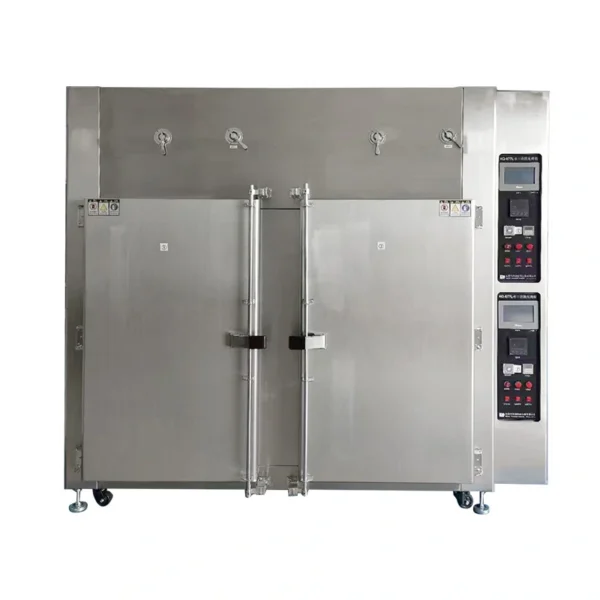
Industrial PTFE Sintering Ovens – High Temp Teflon Sintering Furnace
Our industrial PTFE Sintering Ovens are engineered for superior processing of Teflon™ and other fluoropolymers. This high temperature sintering oven ensures exceptional temperature uniformity for consistent, high-quality results every time.
Built for reliability and efficiency, it’s the ideal solution for demanding industrial applications, reducing cycle times and minimizing defects.
How Teflon Machinery Makes Compliance a Breeze
Look, at Teflon Machinery, we’re not just sellers; we’re partners in this mess. Our ovens? Built with Sintering Oven Safety Standards front and center—think modular designs for easy CE/UL swaps. Head to https://teflonmachinery.com/ for the full lineup, or ping our contact page at https://teflonmachinery.com/contact-us/ for a no-BS chat.
We’ve got engineers who’ve logged thousands of hours on these builds. Want a quote? Shoot an email to info@teflonmachinery.com—I’ll even hop on a call to walk your setup.
Your Playbook: Steps for Compliant Buying
- Map Your Regs: EU? CE mandatory. NA? UL preferred. Cross-check with local OSHA or equivalents.
- Demand Docs: Tech files, DoC, test reports— no shortcuts.
- Test the Gear: On-site audits or third-party verifies.
- Train Up: Operators need certs too—NFPA 86 drills that in.
- Partner Smart: Folks like us at Teflon Machinery handle the heavy lifting.
Follow this, and you’re golden.
FAQ: Quick Hits on Oven Safety
Q: Do all industrial ovens need CE Marking?
A: Nope, but if it’s machinery with moving parts or electrics heading to EU, yeah—directives like 2006/42/EC say so. Skip it, and borders slam shut.
Q: What’s the biggest diff in Sintering Oven Safety Standards between EU and US?
A: EU leans EN 746-2 for broad thermo safety; US hits NFPA 86 for class-specific flammables. Both solid, but blend ’em for globals.
Q: How do I know if a supplier’s UL/CE is legit?
A: Check the mark’s format—UL has a file number; CE needs a DoC. Bogus ones? Red flag. Always verify with the body.
Q: Can one oven cover both CE and UL?
A: Totally, with design tweaks. We’ve done it—saves cash long-term.
There you have it—your roadmap to understanding international safety standards for industrial ovens (CE, UL). Feeling pumped to spec out that next buy? Drop us a line at info@teflonmachinery.com or hit contact us for a free compliance checklist. Let’s get your line firing safely. What’s your biggest worry—hit reply, I’m here.