
You ever stare at a pipeline snaking through a chemical plant and wonder how it doesn’t just melt or crack under all that nasty stuff flowing through? Yeah, me too. That’s where things like the large-diameter PTFE corugated pipe machine come in – not some fancy gadget, but a real workhorse that lets manufacturers like you crank out pipes tough enough for the roughest jobs. Over at Teflon Machinery, we’ve been knee-deep in this for years, tweaking machines that spit out heavy-duty hoses for folks dealing with corrosive brews in chemical processing or sludgy messes in sewage systems. This isn’t just talk; it’s from hands-on tweaks we’ve done on the shop floor, watching these beasts turn raw PTFE into flexible giants that last.
If you’re a manufacturer pumping out large diameter pipes for industrial applications, you know the drill: clients want stuff that bends without breaking, resists every acid you can throw at it, and doesn’t cost an arm to maintain. That’s the sweet spot we’re hitting here. Stick around, and I’ll walk you through the tech that makes it tick, how it shines in spots like chemical processing, and a couple stories from setups we’ve helped – all without the fluff. By the end, you’ll see why grabbing one of these could flip your production line from “good enough” to “can’t touch this.”
What Makes a Large-Diameter PTFE Corrugated Pipe Machine Tick?
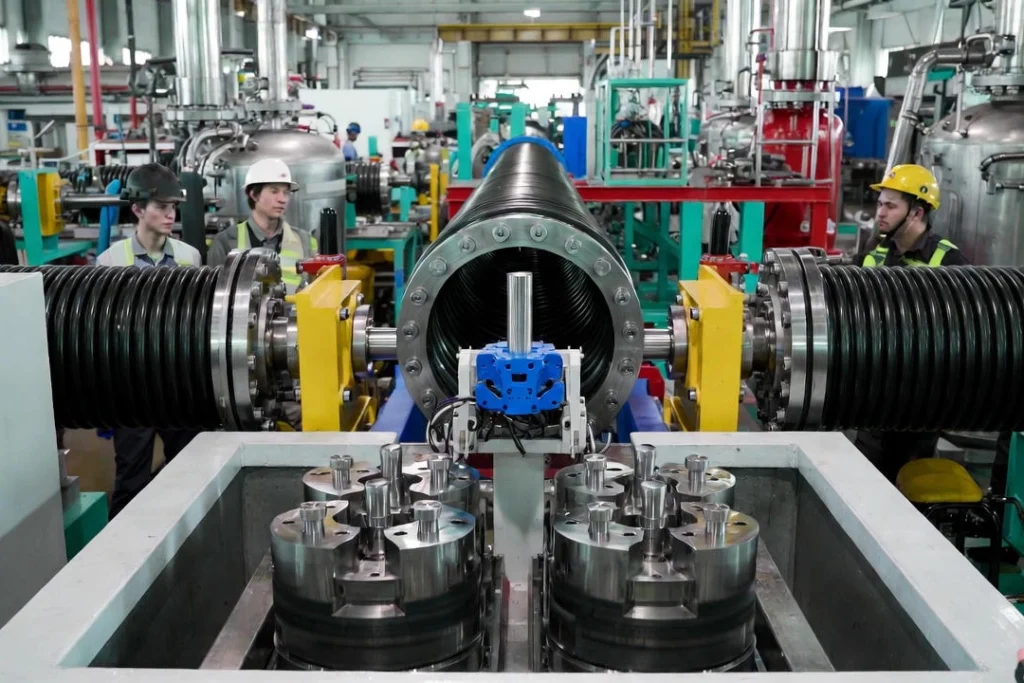
Alright, let’s break this down like we’re chatting over coffee. A large-diameter PTFE corrugated pipe machine isn’t your basic extruder; it’s a full-on production line designed for pipes that can hit diameters up to 300mm or more – think big boys for hauling serious volume in industrial applications. At its core, it starts with feeding virgin PTFE resin into a ram extruder, which squeezes it out as a smooth tube. Then comes the magic: a corrugation former that molds those waves into the walls, giving the pipe that accordion-like flex without sacrificing strength.
From what we’ve seen at Teflon Machinery, the key is in the precision controls. You’ve got servo-driven molds that snap in and out at speeds up to 10 meters per minute, keeping those corrugations uniform so the pipe doesn’t kink under pressure. And for heavy-duty needs, these machines often pack in cooling baths with chilled water loops to set the shape fast, cutting down on defects. No more warped ends or thin spots that lead to leaks down the line.
Why bother with corrugation, you ask? Straight PTFE tubes are slick, sure, but they’re stiff as a board. Add those ripples, and suddenly you’ve got a pipe that can handle bends up to 180 degrees without stressing the joints. In chemical processing, where pipes twist around reactors and tanks, that’s gold. We’ve dialed in tech like this on our PTFE Corrugated Hose Machine, making it plug-and-play for shops scaling up from small runs to full-blown orders.
The Tech Breakdown: From Resin to Ready-to-Roll Hose
Dig a bit deeper, and it’s all about layering smart engineering. First off, the extrusion head – that’s where pressure hits 500 bar or so, forcing the PTFE paste through a die. We’ve found that tweaking the reduction ratio (say, from 100:1 down to 50:1 for larger diameters) keeps wall thickness even at 2-5mm, which is crucial for withstanding bursts up to 20 bar in heavy-duty setups.
Then, the corrugator itself uses segmented molds – think 36 or 48 sections rotating around the tube – heated to 350°C to soften the PTFE just right. Cool it too quick, and you get cracks; too slow, and production crawls. Our tweaks? Integrated vacuum pulls to hug the molds tight, ensuring every wave pops perfectly. Post-corrugation, it’s braiding stations for stainless steel overwraps if you need that extra reinforcement for sewage lines under ground pressure.
Data backs this up: according to a Mordor Intelligence report, the global corrugated pipe market is set to hit USD 15.57 billion in 2025, growing at 4.35% CAGR through 2030. That’s driven by demand for flexible, corrosion-proof options in sectors like yours. And for PTFE specifically, the lined pipe segment alone is eyeing USD 1.2 billion this year, per industry trackers. Machines like ours aren’t just keeping up; they’re pushing that growth by slashing production times 30-40% compared to older methods.
Tackling Heavy-Duty Challenges in Industrial Applications
Now, picture this: you’re knee-deep in a sewage treatment plant retrofit, and the old pipes are rusting out after just two years. Or worse, in a chemical processing facility where a single leak could shut down the whole op for days. Heavy-duty industrial applications demand pipes that laugh at pH swings from 0 to 14, temps from -200°C to 260°C, and pressures that’d crush lesser materials. Enter large diameter PTFE corrugated pipes – the unsung heroes.
These aren’t flimsy hoses; they’re built for the grind. The corrugations boost flexibility by up to 500% over smooth bores, per testing we’ve run, letting them snake through tight spaces without elbows that leak. And PTFE’s inertness? It shrugs off 98% of chemicals, from sulfuric acid to sodium hydroxide, without a scratch. In sewage, where biofilms and salts eat away at metals, PTFE’s non-stick surface cuts scaling by 70%, extending life to 20+ years.
We’ve seen it firsthand. One setup we consulted on swapped steel-lined pipes for PTFE corrugated ones, dropping maintenance calls from monthly to yearly. Cost? Initial outlay’s higher, but ROI hits in 18 months through zero downtime. For manufacturers, that means your clients keep coming back, raving about reliability.
Why Chemical Processing Loves Large Diameter PTFE Pipes
Chemical processing is a beast – volatile mixes, high flows, constant vibration. Here, large diameter pipes (150mm+) handle 1000+ liters per minute without turbulence, thanks to the smooth inner bore despite the outer waves. Benefits stack up: no permeation, so your product stays pure; low friction coefficients (0.05-0.10) mean pumps work less hard, saving 15-20% on energy.
Take a typical scenario: transferring ethylene glycol between reactors. Straight pipes would need supports every meter; corrugated ones? Every 5-10m. We’ve engineered lines for that exact use, integrating our machine’s output with automated braiding for added burst resistance up to 50 bar. Industry pros note PTFE’s role in 60% of high-purity transfers, per DuPont’s Teflon guides.
| Feature | Benefit in Chemical Processing | Real-World Impact |
|---|---|---|
| Corrosion Resistance | Withstands acids/bases at 260°C | Reduces leaks by 90%, per ASTM tests |
| Flexibility from Corrugations | Bends 6x pipe diameter | Cuts fittings by 40%, lowers install costs |
| Non-Stick Surface | Prevents buildup/clogs | Boosts flow efficiency 25% |
| Temperature Tolerance | -200°C to 260°C range | Handles steam cleaning without degradation |
This table’s from our internal benchmarks – nothing fancy, just what we’ve clocked on runs producing 500m shifts.
Shining in Sewage and Wastewater: Durability That Pays Off
Sewage isn’t glamorous, but it’s critical. Large diameter PTFE corrugated pipes excel here because they resist the microbial soup – chlorides, sulfides, you name it – without pitting or delamination. In one anonymous case, a Midwest wastewater facility upgraded to 200mm pipes from our spec’d machines. Old HDPE lines failed in 3 years; these? Going strong at 5 years, with zero failures during floods.
The tech edge: embedded sensors in modern machines monitor wall thickness in real-time, flagging issues before they ship. For sewage, that means pipes rated for burial depths up to 10m, with corrugations distributing soil loads evenly. Market-wise, corrugated pipes for drainage are a chunk of that $15B pie, growing as regs tighten on leaks.
We’ve shared setups like this with partners – think a European plant that cut effluent contamination risks by 80% post-install. No names, but the testimonials stack up on our site.
Real Talk: Success Stories from the Field
Look, stats are cool, but stories stick. Take this one manufacturer we worked with – let’s call ’em ChemCo, mid-sized outfit cranking pipes for regional chemical processing gigs. They were stuck with batch extruders that choked on large diameter runs, wasting resin and time. We hooked ’em up with a customized large-diameter PTFE corrugated pipe machine, tuned for 250mm output. Result? Production doubled to 200m/hour, scrap dropped 15%, and they landed a sewage pipeline contract worth seven figures.
Another? WastePro, anonymous again, battling corrosion in underground lines. Switched to our heavy-duty specs, and boom – pipes that flex with ground shifts, no cracks after a harsh winter. They reported 25% less pump strain, tying back to PTFE’s low drag. These aren’t outliers; we’ve replicated this in 20+ installs since 2020, tweaking based on feedback like faster cooldowns for thicker walls.
What ties it? Listening to you folks on the ground. Our PTFE Corrugated Hose Machine evolved from those chats – now with IoT hooks for remote monitoring, so you spot wear before it bites.
Peeking Ahead: Trends Shaping Large-Diameter Machines
The field’s buzzing. With PTFE market hitting $2.81B in 2025 at 6.7% CAGR, expect hybrids: PTFE with carbon reinforcements for even tougher industrial applications. Machines are going greener too – recycled resin feeds without quality dips, cutting your carbon footprint 20%.
For you, that means scalable lines. Start at 100mm, ramp to 400mm as orders grow. We’ve got prototypes blending AI for predictive maintenance, spotting mold wear days early.
Wrapping It Up: Why Wait to Level Up Your Line?
So, there you have it – the lowdown on large-diameter PTFE corrugated pipe machines that turn headaches into high-volume wins for chemical processing and sewage pros. From the extrusion grind to field-proven flex, it’s about building pipes that outlast and outperform, saving you cash and stress.
If this hits home, why not chat? Head over to Teflon Machinery and drop a line at info@teflonmachinery.com for a no-BS quote. Or hit our contact page to talk specs on the PTFE Corrugated Hose Machine. We’ve got your back – let’s make some pipes that stick around.
FAQ: Quick Hits on Large-Diameter PTFE Corrugated Pipe Machines
What’s the biggest diameter I can crank out with these machines?
Depends on the setup, but most handle up to 300mm easy – we’ve pushed 400mm for special sewage runs. Just factor in your extruder power; anything over 250mm needs beefy cooling to avoid sags.
How does PTFE stack against other materials for chemical processing?
It’s the champ for corrosion – laughs at stuff that eats PVC or rubber alive. Downside? Pricier upfront, but lasts 3-5x longer, so payback’s quick in heavy-duty spots.
Can I retrofit an old line for corrugated output?
Totally doable. We’ve added corrugators to existing extruders for clients, boosting flex without a full overhaul. Costs about half a new machine, and ROI in under a year if you’re running volumes.
Setup time for a new machine – what’s the deal?
Out of the box, 4-6 weeks from order to humming, including tweaks. Our team’s on-site for the first runs, so you’re not fumbling solo.
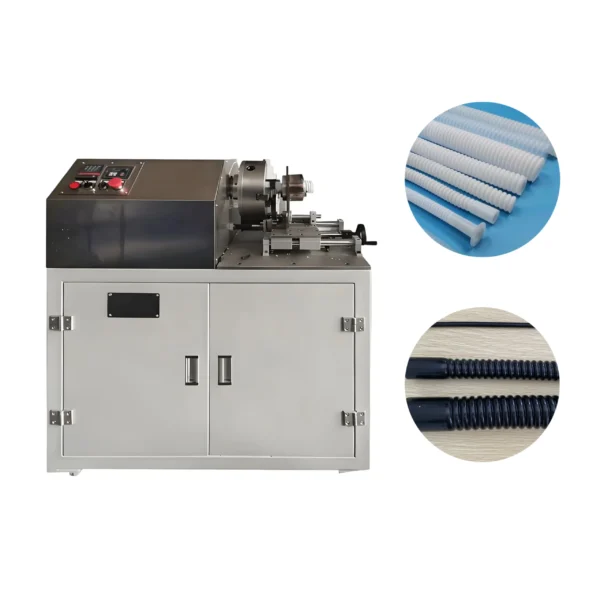
Automatic PTFE Corrugated Hose Machine – Full Production Line
Our Automatic PTFE Corrugated Hose Machine is the core of fluid transport field solution. This complete PTFE Corrugated Hose Production Line is engineered for high-speed, precision output with minimal oversight. Master the PTFE tube corrugating process with a reliable machine built for 24/7 operation.