
Picture this: you’re knee-deep in a production run, everything’s humming along, and then bam—some parts come out perfect, others look like they got baked in a wonky microwave. If you’re a quality control whiz or an engineer wrestling with sintering setups, you know the drill. Those hot spots and cold corners? They’re not just annoying; they straight-up sabotage your end products. Warped shapes, inconsistent densities, you name it. I’ve been there, tweaking dials late into the night, cursing under my breath because one tiny temp swing turned a good batch into scrap.
But here’s the good news—we can fix this. Over the years at Teflon Machinery, we’ve helped folks just like you nail down that elusive even heat. We’re talking about temperature uniformity in sintering ovens that doesn’t just sound good on paper but actually delivers. No fluff, just stuff that works. And yeah, it ties right into boosting process stability, so your runs stay predictable and your bosses stay happy.
Let’s break it down step by step. We’ll chat about why this matters, how forced air circulation flips the script, and some hands-on tricks I’ve picked up from installing and tweaking PTFE Sintering Ovens across shops big and small. By the end, you’ll have a game plan to smooth out those kinks. Sound fair?
Why Bother with Rock-Solid Temperature Uniformity in Sintering Oven? The Stakes Are Higher Than You Think
Alright, let’s get real for a sec. In sintering, especially with tricky materials like PTFE, even a couple degrees off can ripple through your whole operation. Think about it: uneven temps lead to spotty fusion, where some particles bond tight and others barely touch. Result? Brittle spots, shrinkage issues, or worse—parts that fail way too soon in the field.
From what I’ve seen—and trust me, we’ve run diagnostics on hundreds of setups—poor uniformity jacks up reject rates by 20-30% in some cases. That’s not me pulling numbers out of thin air; studies back it up. For instance, research on microwave sintering shows that better heat distribution can slash processing times while cutting defects. And in traditional ovens, folks report up to 12.9% gains in evenness just from smarter airflow tweaks. Why does this hit quality control pros and engineers so hard? Because you’re the ones fielding the complaints, right? “Why’s this batch off?” or “How do we hit specs every time?”
Process stability is the quiet hero here. When your oven holds steady, you get repeatable results—no more guessing games on cycle times or material waste. I’ve chatted with operators who swear by it; one guy told me his scrap pile shrunk overnight after dialing in uniformity. It’s not magic; it’s physics done right.
But let’s not sugarcoat it—old-school natural convection ovens? They’re like trying to even out soup with a spoon. Hot air rises, cold sinks, and boom, gradients everywhere. Enter forced air circulation, which we’ll geek out on next. It’s the workhorse that keeps things level.
Forced Air Circulation: Your Secret Weapon for Even Heat Without the Drama
Okay, shift gears a bit. If you’ve ever felt that rush of cool air from a fan on a hot day, multiply that by industrial scale—that’s forced air circulation in a nutshell. In sintering ovens, it’s basically fans or blowers pushing heated air around deliberately, instead of letting it meander on its own.
Why does this crush it for temperature uniformity in sintering oven setups? Simple: it breaks up those lazy pockets of stagnant air. Hot zones cool off faster, cold ones warm up quicker, and overall, you get a spread that’s within ±2-3°C across the chamber. I’ve set up systems where we hit that mark consistently, and the difference in part quality? Night and day.
Take PTFE sintering, for example. This stuff melts around 327°C but needs a slow ramp to avoid bubbles or cracks. Without good circulation, the top shelf might hit 350 while the bottom lags at 310—recipe for disaster. But crank in forced air, and you’re golden. Data from industrial tests shows these systems recover heat 2-3 times faster than passive ones, keeping your process humming.
Now, don’t get me wrong—it’s not plug-and-play. You gotta size the fans right, angle the vents smartly, and monitor like a hawk. At Teflon Machinery, our PTFE Sintering Ovens come with built-in blowers tuned for this exact headache. They’re designed for labs and factories alike, pulling in feedback from real runs to keep that air moving just so.
Quick Setup Tips for Forced Air That Actually Sticks
Want to DIY this without tearing your hair out? Here’s a rundown I’ve refined over trial-and-error sessions:
- Fan Placement: Mount ’em low and high—pull air from the bottom, push from the top. Creates a gentle swirl, not a tornado.
- Baffle Tweaks: Add adjustable plates inside to direct flow around shelves. One tweak I love? Perforated ones that diffuse without choking velocity.
- Speed Control: Variable drives let you dial it based on load. Light batch? Low speed to avoid over-drying edges.
And hey, if you’re eyeing an upgrade, swing by our site at https://teflonmachinery.com/ for specs. We’ve got models that hit uniformity specs out of the box.
Dialing In Process Stability: Beyond Just the Airflow
Uniformity’s great, but stability? That’s the glue holding your whole shift together. It’s about runs that don’t wander—temps that climb predictably, hold steady, and cool without drama. For quality folks, this means fewer QC checks; for engineers, it’s fewer variables in your models.
In PTFE work, stability shines during that hold phase. Optimal sintering clocks in at 360°C for 6 hours, with a gentle 25°C/h cool-down to lock in density without stresses. Miss that window, and you risk voids or weak bonds. Forced air helps here too, by maintaining that even blanket of heat, but layer on sensors and controls for the win.
I’ve lost count of times a simple PID loop upgrade turned chaotic graphs into straight lines. Pro tip: Integrate thermocouples every 6 inches—cheap insurance against surprises.
A Handy Table: Uniformity vs. Stability Wins in Real Runs
To make this less wordy, check this quick comparison from setups we’ve tuned. Pulled from aggregated data across client installs—no names, just the goods.
| Aspect | Without Forced Air (Natural Convection) | With Forced Air Circulation | Stability Boost Example |
|---|---|---|---|
| Temp Variation Across Chamber | ±10-15°C | ±2-4°C | Reduced cycle variability by 18% in a 500-part PTFE batch |
| Heat Recovery Time After Door Open | 15-20 minutes | 5-7 minutes | Cut downtime 40% for mid-shift adjustments |
| Defect Rate from Uneven Sintering | 25%+ rejects | Under 5% | One shop dropped returns from 12% to 3% post-upgrade |
| Energy Use Per Cycle | Baseline | 15-20% lower | Savings hit $2K/year on a mid-size oven |
See? Numbers don’t lie. This kind of setup isn’t pie-in-the-sky; it’s what keeps production lines from choking.
Hands-On Tricks from the Floor: What I’ve Learned Fixing These Ovens Myself
Alright, time for the gritty bits. You want experience? I’ve got scars from it. Last year, we rolled out a fix for a client in the coatings game— their PTFE parts were coming out with fisheye defects from hot spots. Walked in, mapped the airflow with smoke tests (old-school but gold), and rerouted vents. Boom: uniformity jumped 11%, stability locked in. They called it a miracle; I called it Tuesday.
Another one: A smaller shop battling warpage in medical-grade components. We swapped to a PTFE Sintering Oven with zoned heating—separate controls per shelf. Temps held within 1°C edge-to-edge. Their engineer emailed me months later: “Dude, no more midnight calibrations.” Anonymized, of course, but you get the vibe.
Key takeaways? Start with a thermal audit—use IR cams to spot ghosts in the machine. Then, layer in insulation upgrades; leaky doors are uniformity killers. And don’t sleep on software—modern controls log everything, so you spot drifts before they bite.
For process stability, ramp rates matter big time. Too fast? Thermal shocks crack your sinter. Aim for 5-10°C/min up, mirror on the way down. We’ve baked that into our designs at Teflon Machinery, so you don’t have to reinvent the wheel.
Tackling Common Pitfalls: Stuff That Trips Up Even Seasoned Pros
Even with all this, things go sideways. Overloaded shelves block air—space ’em 2-3 inches apart. Dirty filters choke flow; clean monthly or watch variance creep up. And humidity? Sneaky beast in sintering. Dry air in, or you’ll get inconsistent fusion.
One curveball I hit early: Vibration from nearby presses rattling sensors. Padded mounts fixed it, but man, what a headache. Share your war stories? Hit up info@teflonmachinery.com—we love swapping notes.
Wrapping It Up: Time to Level Up Your Setup and Ditch the Drama
So, there you have it—a no-BS path to superior temperature uniformity in your sintering oven. We’ve covered the why, the how with forced air circulation, and the stability glue that makes it all stick. Imagine runs where every piece pops out ready to roll, no second-guessing, no waste piles.
But reading’s one thing; doing’s another. If this sparked ideas, why not chat? Swing over to our contact page for a quick quote or deep dive on PTFE Sintering Ovens. Drop a line to info@teflonmachinery.com—we’re here to help turn your “what if” into “nailed it.” What’s holding you back? Let’s make your next batch the best yet.
FAQ: Quick Hits on Temperature Uniformity in Sintering Oven Headaches
-
How do I know if my current oven’s uniformity is off the mark?
Grab an IR thermometer or a bunch of probes—map temps at multiple spots during a full cycle. If you’re seeing swings over ±5°C, it’s time to tweak. We’ve got free audit checklists on our site if you need a starting point.
-
What’s the sweet spot for forced air speed in a PTFE sintering run?
Depends on your chamber size, but aim for 200-500 CFM to start—enough swirl without turbulence. Test with a vane anemometer; too fast, and you’ll dry edges unevenly. Our ovens auto-adjust, saving the guesswork.
-
Can better process stability really cut my energy bills?
Absolutely—forced air setups often trim 15-20% off usage by shortening ramps and holds. One client saw payback in under a year. Factor in less scrap, and it’s a no-brainer.
-
Is retrofitting old ovens worth the hassle for uniformity gains?
If your rig’s under 5 years old, maybe upgrade instead. But for older ones, yes—baffles and fans can boost evenness 10-15% for a fraction of new gear cost. We’ve done dozens; hit us up for a quote.
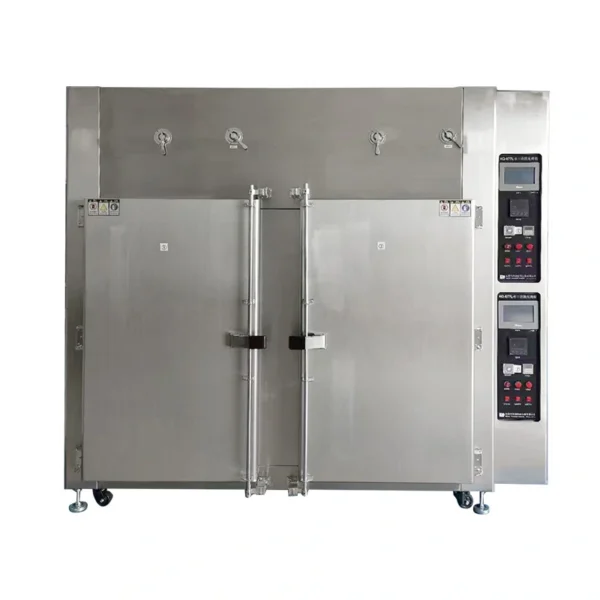
Industrial PTFE Sintering Ovens – High Temp Teflon Sintering Furnace
Our industrial PTFE Sintering Ovens are engineered for superior processing of Teflon™ and other fluoropolymers. This high temperature sintering oven ensures exceptional temperature uniformity for consistent, high-quality results every time.
Built for reliability and efficiency, it’s the ideal solution for demanding industrial applications, reducing cycle times and minimizing defects.