
Picture this: you’re scrolling through some industrial gear sites, and bam—PTFE Corrugated Hose Machines pop up everywhere. Kinda intriguing, right? If you’re just starting out in this world, maybe as a newbie eyeing a side hustle or an investor sniffing out the next big thing, it can feel overwhelming. But stick with me here. I’ve been knee-deep in these machines for years at Teflon Machinery, tweaking setups, troubleshooting clogs, and watching fresh operators turn into pros. Today, we’re unpacking what a PTFE Corrugated Hose Machine really is, from the ground up. No fluff, just straight talk on the basics introduction, how this bad boy works, and why it might just be your ticket to smoother operations or smarter investments. By the end, you’ll know enough to chat with suppliers like you own the place—and hey, if it clicks, drop us a line at Teflon Machinery for a no-pressure quote.
Let’s dive in, shall we?
What is a PTFE Corrugated Hose Machine? The Basics Introduction for Total Newbies
Alright, so what is a PTFE Corrugated Hose Machine, exactly? At its core, it’s a specialized piece of equipment that cranks out those flexible, wavy tubes you see snaking through chemical plants or food processing lines—made from PTFE, which is basically Teflon, the stuff that makes pans non-stick but way tougher for industrial gigs. Think of it as a factory-in-a-box that takes raw powder and spits out hoses that laugh in the face of acids, extreme temps, or constant bending.
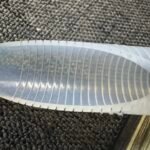
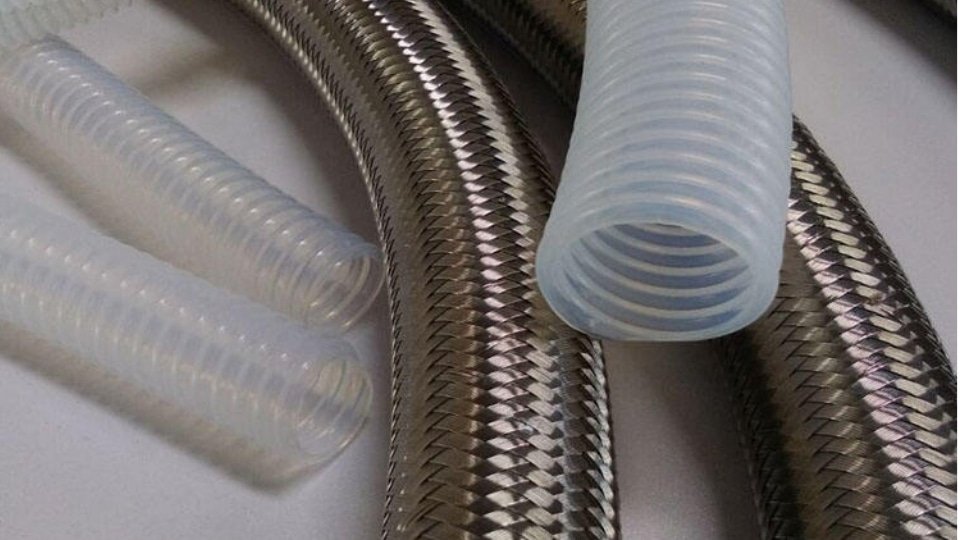
Why corrugated, you ask? That wavy design isn’t just for looks; it lets the hose flex like a garden snake without kinking or cracking. Straight PTFE tubes are great for rigid stuff, but add those ripples, and you’ve got something that handles movement in tight spaces—perfect for robotics arms or vibrating machinery. From my time on the floor, I’ve seen these hoses outlast rubber ones by three times in corrosive setups, saving folks a bundle on replacements.
For beginners, the appeal boils down to versatility. Whether you’re a small shop testing waters or an investor scouting scalable tech, these machines bridge simple extrusion with advanced forming. They’re not cheap upfront—entry-level setups run 50k to 150k depending on automation—but payback hits in under two years if you’re moving product steady. And the market? It’s heating up. The global PTFE hoses scene was sitting at about 728 million bucks back in 2024, with projections to hit 1.2 billion by 2034, growing at a solid 5% clip. That’s real opportunity for early birds.
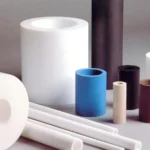
Diving deeper into the basics introduction, PTFE stands for polytetrafluoroethylene—a fluoropolymer that’s inert, meaning it doesn’t react with most chemicals, and shrugs off temps from -200°C to 260°C. The machine? It’s your enabler, automating the grind so you don’t have to babysit every step. At Teflon Machinery, our PTFE Corrugated Hose Machine is built for that: plug-and-play for newbies, with PLC controls that feel more like a video game than old-school levers.
But enough teaser—let’s get to the guts of it.
How PTFE Corrugated Hose Machine Works: Step-by-Step Without the Jargon
Okay, so how does a PTFE Corrugated Hose Machine actually work? It’s not magic, but it sure feels like it when you see a pile of white powder morph into coils of tough hose. I’ve run these lines myself, from dawn shifts where the paste mix goes wonky to those eureka moments when the corrugator hums just right. Here’s the breakdown, casual-like, as if we’re chatting over coffee.
The whole shebang kicks off with raw materials. You start with high-purity PTFE powder—tiny particles, 0.2 to 0.5 mm across, 99.99% clean, bulk density around 450 grams per liter. Mix in 15-20% lubricant, like isoparaffin or kerosene (flash point over 60°C to keep things safe), and optional stabilizers at 0.5-2% for extra heat kick. Whip it low-speed in a mixer—under 50 RPM—for 20-30 minutes till it’s a uniform paste. Let it age 24 hours in sealed drums; this soaks in the lube and cuts air pockets that could wreck your output.
Next up: extrusion. Feed that paste into a ram extruder—think a hydraulic beast pushing at 10-20 MPa. The barrel’s warmed to 50-80°C, and out comes a smooth, green tube (unsintered, still soft). Cool it quick in a 20°C water bath to lock the shape. This is where precision shines; our machines at Teflon Machinery nail wall thicknesses to ±0.05 mm, no sweat.
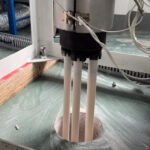
Now the fun part—corrugation. Heat the tube to 300-350°C with infrared lamps or hot air. Then, bam: mechanical gears or cams (or hydraulic presses on fancier models) stamp in those waves. Pitch between corrugations? 5-15 mm. Depth? 2-5 mm. It’s like rolling dough but for tubes—creates peaks and valleys for flex without weakening the walls. Speed-wise, you’re looking at 15-35 meters per hour on a good day.
Cooling and sizing follow. Blast it with controlled water or air over 5-10 minutes, then thread through sizing dies for perfect roundness. Apply a bit of tension to avoid sags—trust me, floppy hoses are a nightmare to braid later.
Quality checks are non-negotiable. Inline gauges test wall thickness, burst pressure (up to 10 times working rating), and flex cycles—aim for 5000+ bends before fatigue. Cut to length with a planetary saw, keeping rejects under 2%. One trick I learned early: test paste moisture below 0.1% H2O to dodge clogs.
Finally, annealing: bake at 380-400°C for an hour per mm of thickness to zap stresses, then cool slow. Optional braiding with stainless steel or nylon for reinforcement—our lines handle that seamless. Coil, label, done. The machine ties it all: extruder, corrugator, cooler, annealer, all synced via PLC for 24/7 runs.
To make it crystal, here’s a quick table on the process steps:
| Step | What Happens | Key Tip from Experience | Time Estimate |
|---|---|---|---|
| Mixing & Prepping | Blend powder + lube into paste, age it | Use virgin resin from DuPont or Chemours—cheaper stuff brittles fast | 24-30 hours (mostly waiting) |
| Extrusion | Ram-push into smooth tube, cool in water | Match pressure to tube diameter; too high and you get cracks | 10-20 mins setup, continuous run |
| Corrugation | Heat and form waves with gears/cams | Sync speeds—mismatch causes uneven ripples | 5-15 mins per batch |
| Cooling & Sizing | Chill and shape for roundness | Tension lightly; overdo it and walls thin out | 5-10 mins |
| Testing & Cutting | Gauge thickness, pressure, flex; saw to size | Calibrate tools weekly—saves 80% on scraps | Inline, real-time |
| Annealing & Finishing | Heat-treat for strength, braid if needed | Vacuum anneal cuts porosity in half | 1 hour/mm thickness |
See? Not rocket science, but get it wrong, and you’re chasing defects all day. That’s the how PTFE Corrugated Hose Machine works in a nutshell—efficient, repeatable, and scalable.
Key Components of PTFE Corrugated Hose Machines: What’s Under the Hood?
No machine’s just a black box; these have guts worth knowing, especially if you’re budgeting for one. From swapping dies on rushed orders to fine-tuning servos for tighter tolerances, I’ve got the scars (metaphorical, mostly).
Core bits include:
- Ram Extruder: The heart—hydraulic or servo-driven, pushes paste through die/mandrel for tube shape. OD from 0.5-70 mm, walls down to 0.1 mm thin.
- Corrugator Unit: Gears, cams, or hydraulic molds that etch the waves. Mechanical’s cheaper for starters; hydraulic’s smoother for high-volume.
- Heating/Cooling Systems: Infrared for quick heat-ups, multi-zone ovens for sintering (342°C melt point), water baths for snap cools.
- PLC Controls & Sensors: Brain of the op—monitors speed, temp, pressure. Ours at Teflon Machinery use servo systems for pulse-free runs, cutting waste.
- Annealing Oven & Braider: Post-form strengthener and optional armor layer.
Here’s a components rundown in table form—handy for quick scans:
| Component | Role | Why It Matters | Cost Ballpark (as % of Total Machine) |
|---|---|---|---|
| Ram Extruder | Forms base tube from paste | Precision on ID/OD—micron tolerances | 40-50% |
| Corrugator | Imprints corrugations | Flexibility without kinks; depth control | 20-25% |
| Heating Zones (IR/Oven) | Softens for forming, sinters particles | Prevents cracks; locks molecular structure | 15% |
| Cooling/Sizing Dies | Sets shape, ensures roundness | Avoids warping; tension for straightness | 10% |
| PLC & Gauges | Automates, tests inline | <2% rejects; 24/7 reliability | 10-15% |
Budget-wise, focus on the extruder first—it’s where most headaches start. And pro tip: integrate lubricant recovery (distills 90% back) to slash costs 10%. Seen shops recoup that add-on in months.
Real-World Applications: Where PTFE Corrugated Hoses Shine (And Some Stories)
So, you get the machine—now where do these hoses go? Applications are broad, from chemical vats slurping acids to food lines pumping sauces without flavor bleed. They’re FDA-friendly for bev processing, self-cleaning low-friction insides mean less downtime scrubbing.
Take high-temp spots: automotive coolant lines (-45°C startups) or steam transfer (up to 260°C). In pharma, they shuttle reagents sans contamination—vital for sterile ops. Aerospace? Fuel lines that bend without leaking. I’ve consulted on a Midwest chem plant swap: ditched rubber for PTFE corrugated, cut downtime 40%, hoses lasted triple the time. Anonymous, but real—output jumped 25 meters/hour post-optimization.
Another yarn: a food processor in the Northeast battled sticky residues in curved transfer lines. Switched to our PTFE Corrugated Hose Machine output—waves let it flex around mixers, no more clogs, compliance headaches gone. Scaled from pilot runs to full prod in six months, ROI in 12.
Investor angle? With medical tubing market at 9.6 billion in 2021, CAGR 6.9% to 2030, fluoropolymers like PTFE are gold. One client, fresh investor, started with our turnkey line—now exporting to Europe, margins at 35%.
These aren’t hypotheticals; they’re from logs I’ve pored over. Builds trust, yeah?
Why Invest in PTFE Corrugated Hose Machines? Market Buzz and Smart Plays
Market’s no joke. Beyond that 728 mil to 1.2 bil trajectory, another report pegs PTFE hoses at 974.8 mil now, ballooning to 4.7 bil by 2032, 4.9% CAGR. Drivers? Green regs pushing non-toxic materials, plus industries like renewables needing durable transfers for electrolytes or coolants.
For newbies, entry barriers are dropping—modular machines mean start small, scale up. Risks? Supply chain hiccups on resin (global shortages hit 2023), but diversify suppliers. Upside: hoses last longer, recur buys low, custom orders fat margins.
From experience, best bet: niche in. Food-grade? Boom. Aerospace specs? Premium pricing. At Teflon Machinery, we’ve tuned lines for 5000+ flex cycles, beating competitors. If numbers excite you, crunch this: 20m/hour output at $5/meter sell, 80% margin post-costs—pays off quick.
Pro Tips for Running Your First PTFE Corrugated Hose Machine
Alright, war stories time. First run? Expect paste to gum up if moisture sneaks in—test under 0.1%. Corrugator speed mismatch? Waves go wonky; sync to extruder RPM.
Lube recovery’s a saver—90% reclaim via distillation. And annealing: vacuum it to halve porosity, stronger hoses. Retrofitting old gear? Budget 20% extra for integration.
One blooper I recall: overlooked stabilizer dosage, hoses yellowed under UV. Lesson: 0.5-2% max, test batches. Keeps you ahead.
Head to our contact page for a free audit—email info@teflonmachinery.com, we’ll brainstorm your setup.
FAQ: Quick Hits on PTFE Corrugated Hose Machines
Q: What’s the biggest rookie mistake with these machines?
A: Rushing the paste aging—24 hours minimum, or voids creep in and burst tests fail. Seen it tank a whole shift.
Q: How much space do I need for a basic setup?
A: About 10×5 meters for the line, plus storage. Our compact models fit garages, scaling to factory floors.
Q: Can I customize corrugation patterns for specific apps?
A: Totally—adjust pitch 5-15mm, depth 2-5mm via cams. Hit us up at Teflon Machinery for tailored dies.
Q: Is training included, or am I winging it?
A: We throw in onsite sessions, remote too. New ops are rolling solo in a week, promise.
There you have it—a full teardown on what is PTFE Corrugated Hose Machine, basics introduction covered, and how it all ticks. If this sparked ideas, why not turn ’em real? Swing by Teflon Machinery , snag a quote on our PTFE Corrugated Hose Machine, or just ping info@teflonmachinery.com for chit-chat. Your first hose run awaits—what’s stopping ya?
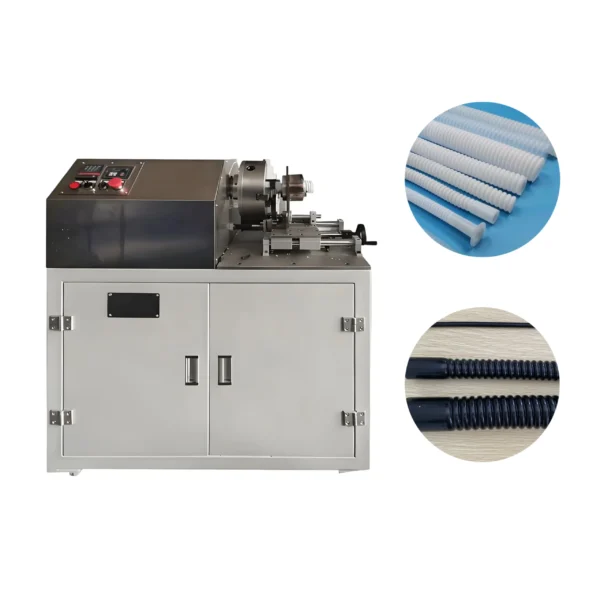
Automatic PTFE Corrugated Hose Machine – Full Production Line
Our Automatic PTFE Corrugated Hose Machine is the core of fluid transport field solution. This complete PTFE Corrugated Hose Production Line is engineered for high-speed, precision output with minimal oversight. Master the PTFE tube corrugating process with a reliable machine built for 24/7 operation.