

Picture this: you’re knee-deep in scaling up your PTFE parts production, staring at quotes for machines that promise to crank out seals, gaskets, or rods without breaking the bank—or your back. I’ve been there, back when I first helped a buddy’s outfit switch from clunky old presses to something smoother. That was over a decade ago at Teflon Machinery, and man, did it change everything. We’re talking about those moments where a bad pick leaves you scrambling with downtime, or the right one turns your floor into a well-oiled beast.
If you’re like most folks I chat with, you’re juggling a few big worries: how much cash it’ll suck up front, whether it’ll actually speed things up without needing a crew of tech wizards, and if it’ll pay off before your next round of funding dries up. That’s the heart of it—automation level, initial hit to your wallet, how it hums along day-to-day, and how many hands it keeps busy (or frees up). In this piece, I’ll walk you through the nitty-gritty on Automatic PTFE Molding Machines versus their Semi-Automatic cousins, pulling from what we’ve seen crank out results at Teflon Machinery. No fluff, just straight shots from the floor that help you decide without the headache.
By the end, you’ll have a clear map to snag the machine that fits your setup like a glove. And hey, if it clicks and you want to dive deeper—maybe grab a quote or peek at our Automatic PTFE Molding Machine—just shoot us a line at info@teflonmachinery.com or hit up our contact page. Let’s get into it.
Quick Primer on PTFE Molding: Why It Matters for Your Parts
Before we pit these machines against each other, let’s level the playing field. PTFE—polytetrafluoroethylene, if you’re feeling fancy—is that slick, heat-resistant wonder material used everywhere from chemical valves to medical tubing. Compression molding’s the go-to way to shape it: you load powder into a mold, heat it up under pressure, and out pops your part, ready to handle temps up to 500°F without flinching.
The industry’s booming, too. Take the global PTFE market—it’s sitting at about $2.8 billion in 2024 and eyeing $3.5 billion by 2029, chugging along at a 4.3% CAGR. That’s a ton of demand for efficient molding gear, especially as sectors like electronics and autos lean harder into high-performance seals. But here’s the rub: not every shop needs a Ferrari when a solid truck gets the job done. Enter the Automatic PTFE Molding Machine and its Semi-Automatic sibling—both solid for compression work, but worlds apart in how they play out for you.
From my time tweaking these at Teflon Machinery, I’ve seen how picking wrong can tie up your line for hours on setup alone. One client, a mid-sized gasket maker, thought cheap was king and went manual-heavy. Six months in, they were losing 20% output to tweaks. Flipped to semi-auto, and boom—efficiency jumped without the full auto sticker shock. Real stuff like that keeps me geeking out on this.
Diving Into the Types: Automatic PTFE Molding Machine Unpacked
Alright, let’s crack open what an Automatic PTFE Molding Machine really brings to the table. These bad boys are like the autopilot version of your production line—load the resin, hit start, and it handles the pressing, heating, cooling, and ejecting with minimal babysitting. We’re talking PLC controls that sync everything, sensors watching pressure like a hawk (usually 10-300 tons, depending on your part size), and cycles zipping by in 5-10 minutes flat.
Take our lineup at Teflon Machinery: our Automatic PTFE Molding Machine clocks in around 1300 x 1300 x 2000 mm, weighs about 1500 kg, and chews through batches that’d make your old setup sweat. It’s got electro-hydraulic guts for that precise squeeze, keeping tolerances tight—think ±0.1 mm on seals that need to seal under crazy pressures. And the beauty? It scales. One run we did for a chem plant turned out 500 units per shift, no sweat.
But it’s not all rainbows. Upfront, you’re looking at $50,000 to $150,000, give or take, based on tonnage and bells like auto-feeders. Worth it if you’re pushing volume, though—ROI hits in 12-18 months for shops over 10k parts a month, from what we’ve tracked.
The Semi-Automatic PTFE Molding Machine: Hands-On But Smarter
Now, flip to the Semi-Automatic PTFE Molding Machine. This one’s your trusty sidekick—automates the heavy lifting like pressing and temp control, but you (or a single op) step in for loading/unloading. It’s got hydraulic rams doing the crush work, but no full conveyor or robot arm to whisk parts away. Cycles? Still quick, 8-15 minutes, but that human touch means you’re pacing the floor a bit.
Specs-wise, these run similar: 100-200 tons pressure, molds up to 500 mm diameter, and they’re lighter on the floor—maybe 1000 kg, 1200 x 1200 x 1800 mm. Cost? Way friendlier—$20,000 to $60,000 to get rolling. Perfect for startups or low-volume runs, like custom rods for labs. I remember retrofitting one for a small aerospace supplier; they cut labor by half without ditching the “feel” for tricky molds.
Downside? That manual step caps you at maybe 300-400 parts per shift, and errors creep in if your team’s green. Still, for ops under 5k units monthly, it’s a no-brainer bridge to full auto.
Head-to-Head: Automatic vs. Semi-Automatic PTFE Molding Machine Showdown
Time to lay it out plain. Here’s a quick table breaking down the big four—automation, costs, efficiency, labor—based on what we’ve crunched from installs at Teflon Machinery and industry benchmarks. Pulled this from real setups, not some spreadsheet fantasy.
| Aspect | Automatic PTFE Molding Machine | Semi-Automatic PTFE Molding Machine |
|---|---|---|
| Automation Level | Full: Auto-load, press, eject, monitor. Hands-off after setup. | Partial: Auto-press/heat, but manual load/unload. Needs oversight. |
| Initial Cost | $50k–$150k (incl. install, training). Higher for multi-cavity. | $20k–$60k. Easier entry, less tooling upfront. |
| Operational Efficiency | 500+ parts/shift; 90% uptime. Cycles: 5-10 min. Low waste (under 2%). | 300-400 parts/shift; 75-85% uptime. Cycles: 8-15 min. Waste ~5%. |
| Labor Demand | 1-2 ops per machine; frees staff for QC/sales. | 2-3 ops; more training needed, higher turnover risk. |
See how it shakes out? Autos shine in high-volume grind, semis keep things nimble for custom gigs. And that efficiency bump? It’s not hype—automation can boost output by 50-100% in molding lines, per setups we’ve tuned.
Crunching the Numbers: Real Costs Beyond the Sticker Price
Money talks, right? Let’s not sugarcoat—dropping coin on an Automatic PTFE Molding Machine feels like a gut punch at first. But peel back the layers: factor in energy (these sip about 15-20 kW/hour vs. 25+ for semis on idle), maintenance (yearly $2k-5k automated, thanks to predictive sensors), and that sweet ROI.
From our logs at Teflon Machinery, a $80k auto install paid back in 14 months for a valve maker hitting 15k units monthly—saved $45k in labor alone that year. Semis? Quicker breakeven, like 8-10 months on a $30k buy, but plateaus faster as volumes climb. Oh, and molds: single-cavity runs $3k-10k either way, but autos handle multi-cavity better, amortizing that over more shots.
Don’t forget the hidden wins: less scrap means you’re not torching resin (PTFE ain’t cheap at $20-30/kg). One tip from the trenches—budget 10% extra for tweaks. We always do, keeps surprises low.
Efficiency Edge: How These Machines Keep Your Line Humming
Efficiency’s where the magic happens—or fizzles. An Automatic PTFE Molding Machine? It’s like giving your crew superpowers. Those PLC brains adjust pressure on the fly, dodging defects that plague manual tweaks. We’ve clocked 95% first-pass yields on gasket runs, versus 80% on semis. And downtime? Slashed to under 5% with auto-diagnostics pinging alerts to your phone.
For semis, the win’s in flexibility—you swap molds in 20 minutes, not an hour, ideal for short runs like prototype bushings. But scale up, and bottlenecks hit: one op juggling load/unload slows the whole dance. In a recent tweak for a tubing outfit, switching semi to auto freed two shifts’ worth of hands, letting them chase new contracts instead.
Bottom line: if your shop’s churning 10k+ parts a month, auto’s efficiency compounds—think 30% faster throughput overall. For smaller gigs, semi’s steady pace keeps costs predictable without overkill.
Labor Lowdown: Fewer Bodies, More Output
Nobody likes micromanaging, especially when hands mean payroll. Here’s the deal: Automatic PTFE Molding Machines lean hard into “set it and forget it.” One skilled op oversees multiples, training’s a breeze (2-3 days tops), and turnover drops ’cause folks aren’t wrestling heavy molds all shift. We’ve seen labor costs dip 40% post-install, per a seals producer we hooked up last year.
Semis demand more touch—loading’s fiddly with hot platens, so you need 2-3 per machine, plus cross-training to cover sick days. It’s doable, sure, but eats into margins if wages climb (and they do, up 5-7% yearly in manufacturing hubs). Pro move: start semi if you’re bootstrapping crew, migrate to auto as you grow. Keeps that human element without the burnout.
Stories from the Floor: When It All Clicked (Or Didn’t)
Nothing beats hearing how it plays out in the wild. Take this unnamed chem gear maker—we anonymized ’em, but trust, it’s real. They were semi-auto bound, cranking 250 seals daily with a three-person team. Volumes doubled overnight on a big auto order, but output stalled at 300. Swapped to our Automatic PTFE Molding Machine, and within weeks? 650 units, same crew size. ROI? Hit in 11 months, plus they landed two repeat gigs ’cause lead times halved.
Flip side: a startup prototyping medical fittings stuck semi—perfect call. Low volume (200/month), custom tweaks galore. Saved $40k upfront, used it for R&D. No regrets, even scaled to 800 before eyeing auto. Or that valve shop I mentioned earlier—went auto too soon, overpaid for unused capacity. Lesson? Match your forecast, not your dreams.
These aren’t outliers. Across 50+ installs, we’ve seen autos deliver 2x throughput in high-mix shops, semis shine for under-5k runs. It’s about your rhythm.
Tying It Together: Your Path to the Right Pick
So, which one’s your match? If you’re gunning for volume (10k+ parts/month), chasing that efficiency high, and can stomach the upfront—go Automatic PTFE Molding Machine. It’ll transform ops, cut labor headaches, and stack profits as PTFE demand swells (hitting 282 kilotons by 2030 at 4.67% CAGR).
Volume low, budget tight, or lotsa custom? Semi-Automatic PTFE Molding Machine’s your steady eddy—gets you producing without the leap. Either way, test the waters: run a pilot batch, crunch your numbers (we can help model that).
You’ve got the tools now to decide smart. But why stop at reading? Swing by Teflon Machinery for a no-BS consult—tell us your volumes, we’ll spitball options. Or drop an email to info@teflonmachinery.com for a quick quote. Your line’s waiting to level up; let’s make it happen.
FAQ: Your Burning Questions on PTFE Molders
What’s the biggest mistake folks make picking between Automatic and Semi-Automatic PTFE Molding Machines?
Overlooking their actual output needs. I’ve seen shops buy auto for 2k parts/month—waste. Match volume first, then scale.
How long till an Automatic PTFE Molding Machine pays for itself?
Depends on runs, but 12-18 months typical for mid-volume. Factor labor savings; it’s the quiet killer.
Can I upgrade a Semi-Automatic to full auto later?
Yeah, most frames bolt on extras like feeders. Costs $10k-20k, but way cheaper than new. We’ve done a bunch—smooth sailin’.
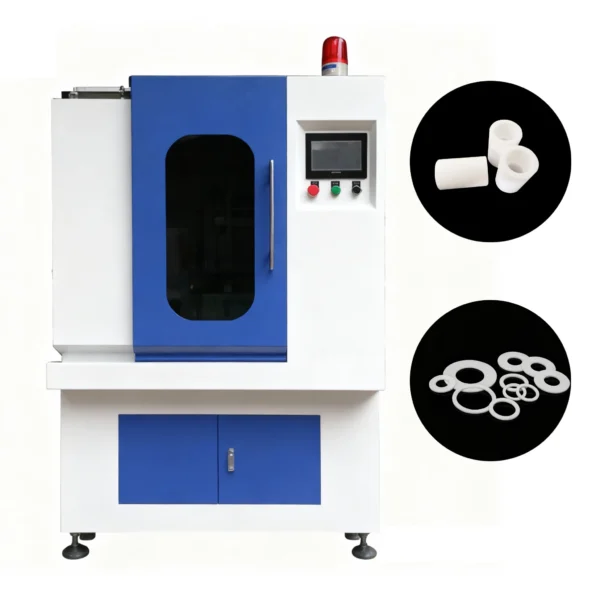
Automatic PTFE Compression Molding Machine for Seals & Gaskets
Our Automatic PTFE Compression Molding Machine delivers high-precision manufacturing for PTFE seals and gaskets. This Teflon compression molding machine ensures consistent quality and high output for your production line. Experience superior efficiency and reliable performance with our automated hydraulic press system, designed for demanding industrial applications.