
You ever stare at a blueprint for a new PTFE hose and wonder, “Okay, but how do I actually make this thing without it turning into a total headache?” As someone who’s spent way too many late nights tweaking extruders in a shop full of humming machines, I get it. Working with PTFE isn’t like slapping together some basic plastic parts—it’s finicky, it’s precise, and picking the wrong process can mean scrapping a whole batch. That’s where ram extrusion and paste extrusion come in, two heavy hitters in the PTFE Hose Extrusion Process.
I’m talking from the trenches here at Teflon Machinery, where we’ve cranked out miles of these hoses for folks in automotive, medical, and chemical gigs. Over the years, I’ve seen engineers scratch their heads over whether to go with a ram setup for beefy, continuous runs or paste for those super-thin, flexible lines. Today, let’s break it down like we’re grabbing coffee and sketching on a napkin—no fluff, just the stuff that matters for your next project. By the end, you’ll know which one’s got the edge for your setup, and maybe even spot a way to chat with us about dialing it in.
What Makes Ram Extrusion Tick? A Closer Look at the Ram Extruder
Alright, picture this: you’re dealing with a solid chunk of PTFE, not some powdery mess. That’s ram extrusion in a nutshell. The Ram Extruder—our go-to model here at Teflon Machinery—takes that preformed billet and shoves it through a heated die with a big ol’ ram. It’s like pushing dough through a pasta maker, but way hotter and under serious pressure.
The beauty? It’s continuous. You load up the billet, fire it up to around 350-400°C in the barrel, and out comes a steady stream of tube. No stopping for batches, which is a godsend if you’re aiming for longer lengths—think rods or tubes up to 10 meters easy, diameters from 5mm all the way to 200mm or more. We’ve used this for industrial hoses that need to handle harsh chemicals without flinching, and the output? Kinda impressive. According to industry stats, ram setups can hit production rates of 10-20 kg/hour for mid-sized tubes, way faster than batch-style methods.
But it’s not all smooth sailing. The wall thickness can get a bit uneven if your billet isn’t spot-on—maybe 0.5mm variance on a 2mm wall, which bites if precision’s your jam. And sintering? That’s the post-extrusion bake at 380°C to fuse it all, locking in that legendary PTFE non-stick vibe. From my time fiddling with these, I’d say it’s killer for structural apps where you need strength over flexibility. One time, we had a client in oil & gas who needed thick-walled liners for pipes exposed to 200°C corrosives. Ram nailed it—zero failures after a year in the field.
Paste Extrusion Unpacked: Why the Paste Extruder Shines for Tricky Stuff
Now, flip the script to paste extrusion. This one’s more like mixing cookie dough before baking—grab fine PTFE powder, blend in 15-20% lubricant (usually naphtha or something similar), and ram it through a cold die. Our PTFE Paste Extruder at Teflon Machinery is vertical for gravity assist, which cuts down on voids and keeps things uniform.
Why vertical? Gravity helps pack the paste evenly, reducing die swell—that annoying expansion when it exits. Temps stay low during extrusion, around room temp, then you stretch and sinter later. Result? Super-thin walls, down to 0.1mm, perfect for flexible hoses in catheters or wire insulation. Production’s batchy, though—maybe 5-10 kg per run, and lengths top out at 50-100m before you gotta restart. But the flexibility? Off the charts. These tubes bend without kinking, and the surface is smoother, with lower porosity for better fluid flow.
I’ve lost count of how many R&D teams we’ve helped switch to paste for medical prototypes. It’s forgiving on material tweaks—like adding fillers for conductivity without wrecking the flow. Downside? That lubricant has to evaporate perfectly, or you get bubbles. Mess that up, and your yield drops 20%. Still, for apps needing micron-level tolerances, it’s unbeatable.
Head-to-Head: Ram Extrusion vs. Paste Extrusion – The Nitty-Gritty Breakdown
So, which one’s “better”? Depends on your headache—throughput or precision? Let’s lay it out in a table, ’cause who has time for walls of text? This is pulled from hands-on runs we’ve done, cross-checked with solid sources.
| Aspect | Ram Extrusion (Ram Extruder) | Paste Extrusion (Paste Extruder) |
|---|---|---|
| Material Form | Solid billet, preformed PTFE | Fine powder + lubricant paste |
| Wall Thickness | 1-10mm (thicker walls shine) | 0.1-3mm (thin & flexible rules) |
| Production Rate | Continuous, 10-50 kg/hr for large dia. | Batch, 5-15 kg/run, slower overall |
| Length Capability | Up to 10m+ continuous | 50-100m per batch, but seamless joins possible |
| Pros | High volume, cost-effective for bulk; strong mechanicals | Uniform walls, high flexibility; great for fillers |
| Cons | Potential wall variance; limited flexibility | Lubricant removal risks; lower throughput |
| Best For | Industrial pipes, chemical liners | Medical tubing, electrical insulation |
| Energy Use | Higher (heated barrel) | Lower (cold process), but sintering adds up |
See how ram edges out on speed, but paste wins on finesse? The global PTFE market’s booming—hitting $2.8 billion in 2024 and eyeing $3.5 billion by 2029 at 4.3% CAGR—mostly ’cause demand for these hoses in EVs and biotech is nuts. If you’re prototyping a hose for high-pressure fuel lines, ram’s your buddy for quick iterations. But for that snaking catheter? Paste all day.
Energy-wise, paste might save you 20-30% on initial power, but factor in drying the lube, and it evens out. Material properties? Both deliver PTFE’s core perks—chem resistance up to 260°C, low friction coefficient of 0.05-0.10—but ram tubes tend to have higher tensile strength (25-35 MPa) for load-bearing, while paste hits better elongation (300-500%) for bendy apps.
Real-World Wins: Stories from the Shop Floor
Nothing beats hearing how this plays out in the wild. Take this one anonymous client—a mid-sized chem processor. They were scaling up for acid transfer hoses, 50mm dia., needing 5km/month. Ram extrusion via our PTFE Ram Extruder cut their lead time from 4 weeks to 10 days, with zero leaks in stress tests at 150 psi. Yield jumped 15%, and they saved a bundle on scrap. We tweaked the die angle to 12° for even flow—small change, big payoff.
Then there’s the med device startup. Thin-walled, 1mm ID hoses for endoscopy, hadda be kink-free under 10° bends. Paste extrusion was the move; our vertical PTFE Paste Extruder let ’em add a biocompatible filler without clogs. First run: 98% pass rate on flexibility specs. They hit FDA trials three months early. Or that auto supplier? Switched from imported ram tubes to local paste for sensor wiring—cut costs 25% and boosted dielectric strength to 20kV/mm.
These aren’t cherry-picked; they’re the kinda tweaks we do weekly. In engineering, it’s about matching the process to the pain point—ram for volume beasts, paste for precision dancers.
When to Pull the Trigger: Picking Your Extrusion Path
Alright, you’re nodding along, but how do you decide for your gig? Start with specs: Wall under 2mm? Paste. Need 100m+ runs? Ram. Budget crunched? Ram’s cheaper per meter long-term, especially at scale. And don’t sleep on hybrids—some setups blend both for multi-layer hoses.
From experience, test small. Prototype a 10m run on each, measure tolerances with a micrometer (aim for <0.05mm variance), and run burst tests per ASTM D1599. If it’s chemical exposure, check permeation rates—PTFE’s at 0.01 g/m²/day for most acids, but process affects it slightly.
The PTFE extruded tubes market’s set to grow 5-6% yearly through 2030, driven by green energy hoses. If you’re in R&D, paste lets you experiment with carbon nanotubes for conductivity without melting down. Ram? Perfect for scaling those wins.
Stuck? Hit up teflonmachinery.com for a free consult—we’ve got sim software to model your flow before you buy. Or drop a line to info@teflonmachinery.com; we’ll crunch numbers on quotes faster than you can say “sinter cycle.”
FAQ: Quick Hits on Ram vs. Paste Extrusion
What’s the biggest headache with switching from ram to paste extrusion mid-project?
Man, it’s the reformulation—ram billets are dry, paste needs that lube mix tuned just right, or your viscosity goes haywire. We’ve seen 10% yield dips from bad ratios, but a quick lab tweak fixes it. Pro tip: Start with 18% lubricant for standard PTFE.
Can I use a Ram Extruder for thin medical hoses, or is Paste Extruder non-negotiable?
You could, but why fight it? Ram struggles below 1mm walls—gets wavy. Paste’s cold push keeps it straight and supple. For med stuff, regs like ISO 10993 demand that uniformity; we’ve cert’d dozens that way.
How does the PTFE Hose Extrusion Process impact overall costs?
Upfront, ram’s lower at $0.50-1/m for bulk, paste $1-2/m for specialty. But factor labor: Ram’s hands-off, paste needs monitoring. Long run, ram wins for high-volume; we’ve shaved 30% off client bills by optimizing.
Any tips for troubleshooting voids in paste extrusion?
Yeah, air pockets love hiding in the preform. Degass your powder 24 hours pre-mix, and use a vibratory feeder. One client cut voids 40% that way—game-changer for leak-free hoses.
Look, we’ve been knee-deep in this at Teflon Machinery for years, turning “what if” sketches into production lines. If this sparks ideas for your next hose design, swing by our contact page and let’s talk shop. Quotes are free, advice is better, and who knows—might just save your project from a costly detour. What’s your biggest extrusion puzzle right now?
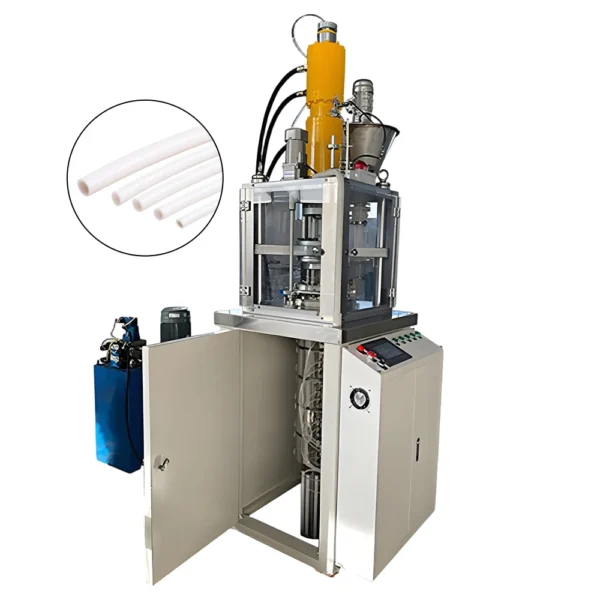
PTFE/Teflon Vertical Ram Extruder for Tubes/Pipes
Discover the advanced PTFE Vertical Ram Extruder, designed for precise production of high-quality PTFE rods and tubes. This automatic ram extruder ensures superior extrusion efficiency, reducing energy consumption while delivering consistent results in demanding industrial applications.
Ideal for manufacturing seals, gaskets, and electrical insulators, our hydraulic ram extruder handles virgin PTFE and filled compounds with ease. Experience unmatched stability and output in PTFE rod extrusion, minimizing downtime and maximizing productivity for your operations. With innovative vertical design, it eliminates stress on unsintered material, perfect for B2B clients seeking reliable PTFE tube extruder solutions.
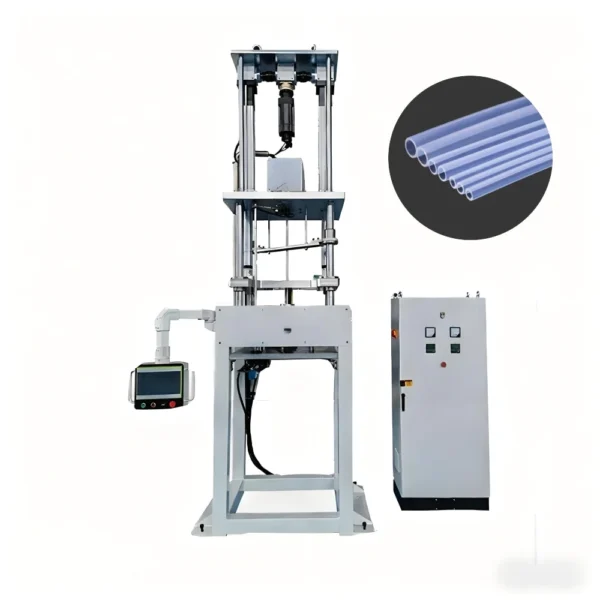
High-Precision Vertical PTFE Paste Extruder – Medical Tubing
Produce ultra-precise medical-grade tubing with our High-Precision Vertical PTFE Paste Extruder. This automatic extruder ensures exceptional dimensional accuracy and consistency for catheters and other critical medical applications. Our Hydraulic PTFE Paste Extruder offers reliable, continuous operation for superior results.